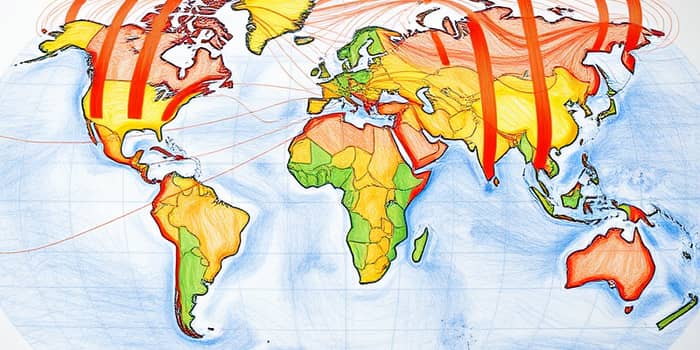
In an interconnected world facing new challenges, national leaders and citizens are rethinking the value of open borders and unbridled trade. This article explores the causes, consequences, and possible remedies to the protectionist surge reshaping global commerce.
The contemporary anti-globalization backlash can be defined as a wave of rising political and public resistance to deeper economic integration. Fueled by nationalism, populism, and skepticism toward multilateral institutions, this movement aims to shield domestic firms from foreign competition through a range of measures: tariffs, quotas, subsidies, and stringent local-content rules.
Rather than a wholesale reversal of decades-long integration, analysts describe the phenomenon more accurately as a slowdown and fragmentation of globalization. While global trade volumes remain substantial, policy frameworks are increasingly driven by strategic caution, fragmenting once-familiar supply chains.
Citizens in many countries express concern that free trade agreements have favored large corporations over small businesses and workers. The narrative that trade is a zero-sum game—one nation’s gain at another’s expense—has supplanted the older “win-win” paradigm, eroding public trust in institutions like the World Trade Organization.
Several deep-rooted trends have converged to propel protectionism into mainstream policy. Understanding these drivers is key to crafting balanced responses.
While each factor today influences trade policy, they also interact, amplifying protectionist pressures across the globe.
1. Economic inequality and left-behind regions have fueled resentment as manufacturing hubs in advanced economies saw major job losses over the past two decades. In the American Midwest and the British Midlands, communities once thriving on factory work witnessed closures and offshoring without commensurate support for retraining. According to the IMF, globalization may have increased spatial inequality, stoking demands for trade barriers even when they risk worsening local hardship.
2. Nationalism and populism have transformed trade and immigration into cultural flashpoints. Political leaders, from Brexit campaigners to “America First” advocates, frame cross-border exchanges as threats to identity and sovereignty. Protective rhetoric now commands mainstream appeal, with broad calls for tariffs and reshoring resonating in electorates worldwide.
3. COVID-19 exposed deep supply-chain vulnerabilities, especially in pharmaceuticals, semiconductors, and personal protective equipment. Lockdowns, export bans, and border closures revealed the dangers of overreliance on specialized producers. Governments responded by pledging to “de-risk” supply chains, often in ways that limit free trade.
4. Geopolitical fragmentation, driven by US–China rivalry and Russia–Ukraine tensions, has turned economic policy into an instrument of statecraft. Sanctions, investment screenings, and export controls now dictate strategic alignments. The World Economic Forum ranks geoeconomic confrontation as a top global risk, highlighting how security fears can override efficiency considerations.
5. The revival of industrial policy reflects a shift toward economic sovereignty over pure market logic. Large subsidy programs—such as the US Inflation Reduction Act and India’s Make in India initiative—seek to build domestic capacity in green technology and critical inputs. While bolstering resilience, these measures also erect new barriers to cross-border investment.
Quantitative indicators reveal the gravity of the shift. Global Trade Alert reports that harmful trade interventions jumped from around 600 in 2017 to over 3,000 annually in 2024. The majority of these are subsidies, illustrating a move away from simple tariff skirmishes toward a more complex, managed trade environment.
Trade growth rates have slowed markedly. In the Asia-Pacific region, goods and services exports are projected to increase by just 1.1% in 2025, down from 6.1% in 2024. Analysts warn of a potential spiral of tit-for-tat restrictions that could shrink world trade volumes and dampen global growth.
Foreign direct investment likewise has contracted. UNCTAD’s 2024 report links a 10% slump in global FDI to fractured regulatory regimes and heightened uncertainty. Many multinational firms have delayed or cancelled projects amid fears of policy reversals and sudden tariffs.
Protectionist measures often deliver unintended economic consequences. Tariffs can lead to higher consumer prices and lower real incomes, while subsidies may distort competition and trigger retaliatory actions. Over the long term, these practices risk eroding productivity by diverting capital into less competitive sectors.
Geoeconomic blocs are forming, but decoupling remains incomplete. Bilateral trade between major powers continues at substantial volumes, reflecting the interdependence that decades of integration have forged. This partial fragmentation suggests that outright disengagement is both undesirable and practically unachievable.
Rather than choosing between unfettered openness and rigid protectionism, policymakers can adopt a middle path: Globalization 2.0. This framework balances efficiency with resilience, ensuring the benefits of trade are widely shared and strategic risks contained.
Implementing these strategies requires close collaboration between governments, businesses, and civil society. Public-private partnerships can strengthen critical supply lines, while cross-border research alliances accelerate innovation in green energy, biotechnology, and advanced manufacturing.
Reforming trade governance also means empowering global institutions to address 21st-century challenges. By integrating environmental, labor, and digital regulations into trade agreements, the world can create a more equitable and sustainable system.
At the national level, transparent policy frameworks that combine incentives with clear adjustment programs can help workers and communities adapt to economic change. Fiscal support for displaced employees, regional development funds, and targeted infrastructure investments are all vital components.
The anti-globalization backlash presents both a warning and an opportunity. Without measured response, protectionism could fracture the global economy into rival camps, diminishing the shared gains of decades of cooperation. Yet, by embracing a reimagined form of integration—one that is inclusive, secure, and sustainable—we can overcome today’s divisions.
History teaches that isolation rarely delivers enduring prosperity. A balanced approach, underpinned by robust social policies, strategic safeguards, and reinvigorated multilateralism, can renew trust in global collaboration. Collective action informed by data and driven by empathy will be essential.
Ultimately, the success of globalization 2.0 depends on our willingness to learn from past missteps and innovate in policy design. By building bridges instead of walls, we can chart a course toward a vibrant, resilient, and inclusive global economy for future generations.
References