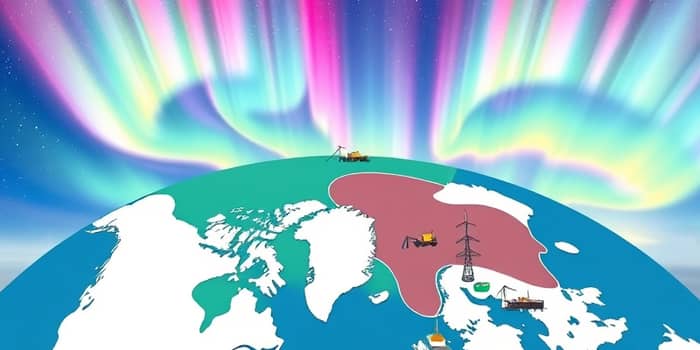
The Arctic, once a symbol of pristine wilderness, now stands at a critical juncture where geopolitical tensions and immense investment potential intersect, defining a new era of global strategy.
With Russia's 2022 invasion of Ukraine, the region has fractured into competing blocs, disrupting decades of cooperation and setting the stage for a Russia-dominated Eurasian Arctic to clash with Western interests.
This shift has profound implications, as the United States recalibrates its approach to emphasize dominance in the Western Hemisphere, including strategic assets like Greenland, amidst a backdrop of climate change and resource competition.
The Arctic has divided into three primary spheres, each with distinct agendas and alliances.
A Russia-led Eurasian bloc, a Nordic and Scandinavian European Arctic, and a North American zone involving the U.S., Canada, and Greenland are now vying for influence.
Russia's actions have led to the suspension of the Arctic Council, halting circumpolar collaboration and forcing nations to rely on limited bilateral ties such as Norway-Russia fisheries in the Barents Sea for essential cooperation.
Finland and Sweden joining NATO in 2023 and 2024 respectively has prompted Russia to pivot towards China, India, and other BRICS+ partners for trade and scientific endeavors in the north.
This realignment threatens to undermine NATO unity, especially with scenarios like potential U.S. annexation of Greenland or Russian moves on Svalbard in 2026.
The U.S. strategy now focuses on spheres of influence, prioritizing security and resilience in a region warming at 4x the global average, which unlocks new access but also escalates tensions.
Investors are pouring over USD $1 trillion into Arctic infrastructure, with half of that already planned, signaling a massive commitment to transforming the region.
This includes roads, ports, airports, and housing, aimed at supporting industrial and societal resilience in the face of rapid change.
Key sectors driving this investment offer diverse opportunities for growth and innovation.
Norrbotten, in the European Arctic, exemplifies this potential with strengths in minerals, wireless technology, and space industries, though it requires partners for value chain development.
The Arctic is rich in critical resources, such as Greenland's Tanbreez mine with 18% of the world's rare earths, drawing intense U.S. interest for green tech and security needs.
Energy and shipping routes, like Russia's Northern Sea Route, are becoming focal points of tension, while climate change poses severe risks but also opens new avenues for sustainable development.
Canada is investing C$40 million in Indigenous services and upgrading the Port of Churchill to enhance Arctic connectivity, highlighting the need for inclusive development.
Key data points underscore the scale and urgency of this transformation.
This table highlights the tangible assets and challenges that shape investment decisions and geopolitical strategies.
The melting ice presents both dangers and chances, with security risks from Russia and China's ambitions juxtaposed against opportunities for sustainable growth.
Challenges include environmental instability, geopolitical fragmentation, and infrastructure gaps.
Opportunities abound, offering pathways to resilience and prosperity.
These elements require balanced approaches to mitigate risks while capitalizing on potential.
Looking ahead, 2026 is poised to be a pivotal year with events focusing on investments, sovereignty, and collaboration.
Potential scenarios include annexation attempts by major powers, testing NATO's deterrence capabilities.
Key events to watch include the Demo North Summit, Arctic Summit, and Arctic Frontiers, which will address critical themes.
To navigate this crossroads, stakeholders must prioritize strategic actions.
As the Inuit Tapiriit Kanatami emphasizes, this is a time for generational Arctic investments amid increasingly "spicy" global dynamics.
The Arctic's future hinges on balancing competition with cooperation, ensuring that this fragile yet vital region becomes a beacon of innovation rather than a battleground.
By embracing the challenges and seizing the opportunities, we can chart a course towards a more stable and prosperous Arctic for all.
References