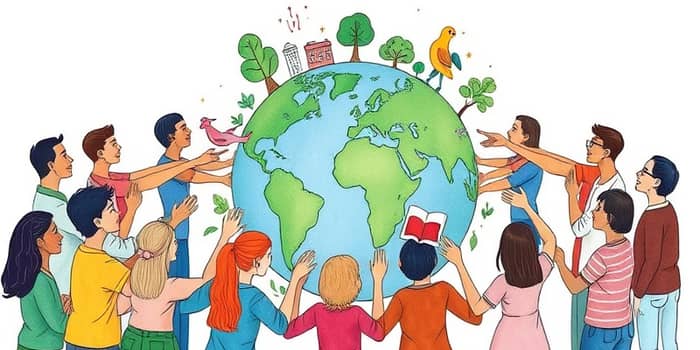
For decades, Gross Domestic Product (GDP) has been the go-to metric for assessing economic success, but it paints an incomplete picture of our world's true prosperity.
It focuses solely on monetary transactions, often overlooking what truly matters for human flourishing and planetary health.
This narrow view fails to account for vital aspects like environmental sustainability and social equity, leaving us blind to the full costs of growth.
As global challenges from climate change to inequality intensify, there is a growing urgency to rethink how we measure progress.
This article delves into why GDP falls short and introduces practical alternatives that inspire a more comprehensive approach to economic health.
By embracing these new metrics, we can foster policies and mindsets that prioritize well-being for all, today and for future generations.
GDP measures total national spending on final goods and services, including consumption, investment, government spending, and net exports.
However, it does not distinguish between activities that enhance well-being and those that harm it, such as pollution production.
This oversight means that economic growth can appear positive even when it leads to environmental degradation or social decline.
For instance, since 1970, global GDP has doubled while resource extraction tripled, highlighting the unsustainable nature of current growth patterns.
Moreover, GDP ignores non-monetary factors that are crucial for a thriving society.
It leaves out elements like health, education, and income inequality, which are fundamental to quality of life.
Unpaid household and volunteer work, which contribute significantly to communities, are also excluded from this economic tally.
By equating increased consumption with progress, GDP overlooks negative externalities such as ozone depletion and climate change.
This can lead to policies that prioritize short-term gains over long-term sustainability, perpetuating social inequities and environmental harm.
To address these gaps, we need metrics that capture a broader view of prosperity.
These limitations underscore the need for alternative indicators that reflect true well-being.
Alternative metrics adjust GDP for social and environmental costs or incorporate subjective and non-monetary dimensions.
They aim to provide a more holistic view of progress, integrating aspects like arts, culture, and democratic engagement.
Below is a table summarizing some of the key indicators being used or developed worldwide.
These indicators help shift the focus from mere economic output to comprehensive well-being, encouraging policies that value holistic health and sustainability.
They are part of a growing movement to redefine prosperity in ways that matter for people and the planet.
By adopting such metrics, societies can better align economic activities with human and ecological needs.
Many cities, states, and countries are already implementing these alternative indicators to guide policy and community development.
This grassroots adoption demonstrates the practical value of moving beyond GDP in everyday decision-making.
For example, Santa Monica uses a Wellbeing Index to track quality of life drivers, while Seattle incorporates Gross National Happiness principles.
At the national level, New Zealand's Living Standards Framework integrates well-being into all government policies, emphasizing stakeholder perspectives.
International organizations like the OECD promote the Better Life Index, and the UN advocates for the Human Development Index and Multidimensional Vulnerability Index.
These efforts are supported by events like the Beyond Lab, which urges global commitments to complement GDP with natural and social capital metrics.
These real-world examples show that shifting toward holistic measures is not just theoretical but actively improving lives.
Alternative indicators redefine prosperity by aligning economic goals with sustainable consumption and holistic health.
They help policymakers invest in areas that enhance individual and collective well-being, rather than just boosting spending.
For cities, this means promoting public reporting, developing localized metrics, and convening stakeholders for collaborative action.
It also supports intergenerational equity by considering long-term impacts, such as debt relief for natural disasters or green clauses in agreements.
By complementing GDP with tools like GPI and Ecological Footprint, we can reveal the intricate links between income, environment, and life quality.
This approach fosters a more resilient and inclusive economy, where small states and underrepresented communities have a voice.
Embracing these changes requires courage and collaboration, but the benefits are profound for global stability.
Despite their promise, alternative indicators face several challenges that must be addressed for widespread adoption.
Subjectivity in data collection, such as from surveys or social media, can make tracking difficult and less reliable.
Standardization is another hurdle, as the lack of uniform sources inhibits cross-comparisons and scaling efforts.
Some metrics, like GPI, still carry biases by linking to consumption, which may disadvantage resource-exporting nations.
To mitigate these issues, experts recommend using mixed suites of traditional and experimental indicators for a balanced view.
Establishing multilateral committees under the UN can foster coherence and data sharing across countries.
Expanding cooperation and centering youth and underrepresented groups in these conversations is crucial for inclusive progress.
By addressing these challenges, we can pave the way for a more equitable and sustainable economic system.
The shift beyond GDP is part of a larger movement to reimagine economic health in the face of global crises.
It calls for legislative and policy changes, such as those discussed in forums like FfD4, to prioritize comprehensive wealth over mere growth.
Pioneering metrics like the Human Development Index have already shown how complementary measures can aid in this transition.
This broader context emphasizes that true prosperity involves balancing economic, social, and environmental dimensions for long-term sustainability.
It inspires us to think creatively and act collectively, ensuring that our economic systems serve humanity and the planet.
As we move forward, embracing these alternatives can lead to a world where well-being is at the heart of every decision.
By measuring what truly matters, we can build a future that is not only prosperous but also just and enduring for all.
References