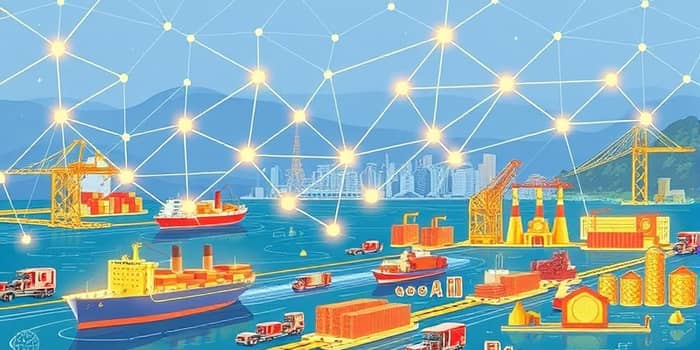
In today's interconnected global economy, supply chain finance (SCF) plays a crucial role in ensuring smooth financial flows between buyers and suppliers.
However, traditional SCF often struggles with opacity, high costs, and fraud, hindering growth and efficiency.
Blockchain technology emerges as a game-changer, offering a decentralized ledger that enhances transparency and trust.
This article explores how blockchain integration addresses SCF challenges, providing practical insights for businesses aiming to optimize their operations.
By leveraging blockchain, companies can achieve immutable, real-time visibility across every transaction, from raw material sourcing to final payment.
This not only mitigates risks but also fosters collaboration among supply chain actors, making finance more accessible and reliable.
We delve into the key advantages, real-world applications, and actionable steps to harness this technology for a more resilient supply chain.
Supply chain finance optimizes cash flow by mitigating payment and performance risks, accelerating receivables, and extending credit.
Blockchain enhances this by synchronizing material, information, and financial flows through its decentralized architecture.
A single source of truth is created, where all stakeholders have access to the same data in real-time.
This eliminates information asymmetry and reduces inefficiencies, such as delays and errors in documentation.
For instance, smart contracts can automate payments upon delivery, ensuring faster settlements and reducing the need for intermediaries.
The result is a more transparent, efficient, and trustworthy financial ecosystem that supports both large corporations and SMEs.
Blockchain brings multiple benefits to SCF, transforming how businesses manage financial transactions.
Here are some of the most impactful advantages:
These advantages collectively improve cash flow and reduce operational bottlenecks.
For example, a PwC report indicates that blockchain can cut trade finance processing times by up to 50%.
This makes SCF more accessible to exporters and importers worldwide.
Numerous platforms and industries have successfully adopted blockchain to enhance SCF transparency.
These examples highlight the practical applications and benefits:
These implementations show how blockchain can be tailored to various sectors, driving innovation and trust.
The adoption of blockchain in SCF is growing rapidly, with promising market trends.
Key data points include:
These projections underscore the economic impact and scalability of blockchain technology in financial ecosystems.
While blockchain offers significant benefits, adopting it in SCF comes with challenges that must be addressed.
Here are the key hurdles and requirements:
Overcoming these challenges involves collaboration, strategic planning, and incremental implementation.
For instance, starting with pilot projects can help businesses test blockchain solutions without disrupting existing operations.
Blockchain in SCF is often enhanced by other emerging technologies, driving innovation forward.
Key trends include:
These technologies complement blockchain, creating a holistic approach to supply chain management.
Research indicates a shift towards collaborative business models, where transparency fosters trust and resilience.
To leverage blockchain for SCF transparency, businesses can follow actionable steps.
Start by assessing current SCF pain points, such as delays or fraud incidents.
Engage stakeholders early to build consensus and define clear objectives for transparency improvements.
Select a blockchain platform that aligns with your industry needs, like TradeLens for logistics or Clipeum for KYC.
Pilot the technology in a controlled environment, focusing on high-impact areas like automated payments.
Monitor results and scale up gradually, integrating with existing ERP systems to ensure compatibility.
Continuous learning and adaptation are key, as the technology evolves rapidly.
By taking these steps, companies can enhance their SCF processes, driving efficiency and trust in their supply chains.
References