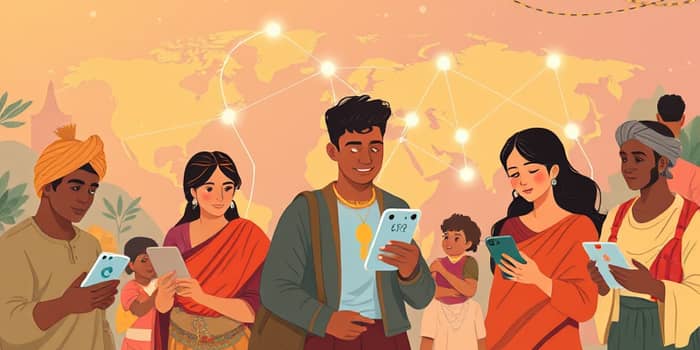
In a world where 1.4 billion adults remain unbanked, access to basic financial services is the missing key to unlocking personal and community potential. From remote villages in sub-Saharan Africa to informal markets in South Asia, the divide between those with formal accounts and those without is stark. Yet, across continents, visionaries are harnessing technology to bridge this chasm. This article offers a deep dive into the global landscape, explores transformative breakthroughs, and shares practical strategies to build a more inclusive financial future.
Financial exclusion persists at an alarming scale. Globally, 1.4 billion adults lack formal financial accounts, while 345 million micro-enterprises in emerging markets operate informally. The gender gap remains pronounced: 785 million women do not have mobile internet access, undermining digital engagement and economic autonomy. In many communities, a missing digital ID is a barrier to opening accounts or obtaining credit. These gaps translate into lost livelihoods, stunted business growth, and limited emergency savings.
Behind each statistic is a human story. In rural Pakistan, a mother of five must pay high fees to send remittances through middlemen. In remote Latin America, a smallholder farmer cannot insure his harvest against drought. Understanding these real-world impacts underscores the urgency of closing inclusion gaps and catalyzes empathy-driven innovation.
Over the past decade, a new generation of financial tools has emerged. Mobile money platforms have evolved from basic peer-to-peer transfers to comprehensive ecosystems offering savings, insurance, and agricultural financing. Digital identity frameworks now enable secure enrollment, opening doors to online lending and government benefits. Fintech start-ups leverage big data and AI to underwrite loans within minutes, reducing reliance on subjective credit assessments.
Key enablers include:
Major telecom operators and payment innovators are combining efforts to deploy low-cost mobile technology deployments, enabling even the poorest to transact, save, and borrow without stepping into a branch. Stablecoins and programmable wallets further reduce transaction times and fees, particularly across borders, fostering new trade corridors for small traders.
Technology is only one piece of the puzzle. Resilient ecosystems demand collaboration among regulators, financial service providers, technology firms, and community organizations. Kenya’s FinAccess program and South Africa’s FinScope surveys exemplify how durable data infrastructure informs policy and directs funding to underserved regions. By continuously mapping needs and outcomes, these initiatives create feedback loops that refine product offerings and deepen impact.
Local agent networks anchor digital finance in communities. In one striking example from Pakistan, a grassroots network of 300+ rural branches and trained agents helped a microfinance bank grow its loan portfolio five-fold in five years, reaching over 400,000 clients. Tailored financial literacy workshops, delivered in local dialects, and transparent fee structures built trust and encouraged repeat transactions.
To sustain momentum, stakeholders should invest in cross-sector data sharing and governance frameworks. Public-private partnerships can underwrite infrastructure costs, while university research centers and mission-driven incubators explore emerging use cases—ensuring that innovations remain ethical and consumer-centric.
As we pivot from access to depth of impact, four trends stand out. First, AI-driven orchestration of permissioned data unlocks personalized credit scoring. Second, hybrid service models blend digital channels with human empathy, reaching tech-averse populations. Third, predictive risk simulations enable financial institutions to anticipate market shocks and design responsive products. Fourth, gender-focused ID and payment initiatives promise to reduce usage gaps by 10 points by 2035.
These innovations converge to create what some experts term “smart money”—funds that self-adjust interest rates based on risk profiles, and that can be programmed to support climate-resilient farming or education goals. When paired with robust governance, smart money can elevate millions from subsistence to stability.
To translate promise into practice, aligned policy frameworks and strategic partnerships are essential. Key actions include:
Investors can support mission-oriented funds that blend research and capital, while multinational corporations can embed financial inclusion goals into supply chain programs. Civil society groups play a watchdog role, ensuring that consumer protections evolve in step with technology.
By 2030, implementing digital ID for every woman could unlock up to $13.78 trillion in GDP growth. In Latin America and the Caribbean, fintech numbers have swelled by 340% since 2017; in Africa, fintechs doubled from 450 to 1,263 between 2020 and 2024. Yet funding cuts and talent gaps threaten to stall progress, especially in last-mile markets.
The journey ahead calls for renewed optimism and deliberate action. Stakeholders must prioritize durable public-private infrastructure, invest in human capacity, and embed ethical AI governance. Every community leader, policymaker, and entrepreneur has a stake in shaping an inclusive future.
Together, we can close the chasm that has left billions on the sidelines. Through collaboration, innovative design, and unwavering commitment to equity, financial inclusion can evolve from an aspiration into a global reality—unlocking opportunity and catalyzing prosperity for all.
References