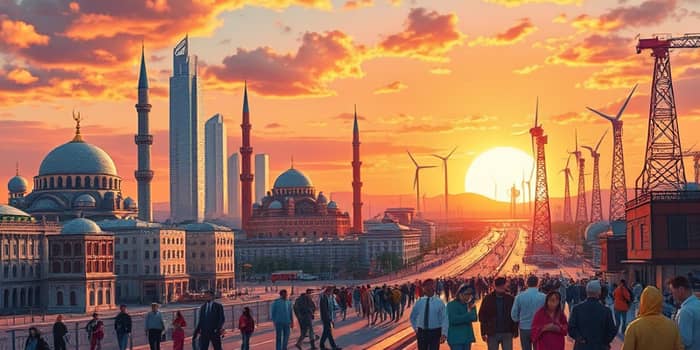
In the heart of Eurasia, Central Asia stands at a pivotal juncture, poised to transform from a historical crossroads into a dynamic economic powerhouse. With projections showing robust growth, this region is emerging as a beacon for global investors and visionaries.
Forecasts predict robust growth across Kazakhstan, Kyrgyzstan, Tajikistan, Turkmenistan, Uzbekistan, and Mongolia, driven by a youthful population and strategic initiatives. This convergence of factors creates unparalleled opportunities for those willing to explore and engage.
As the world seeks new frontiers, Central Asia offers a compelling narrative of resilience and innovation. Its journey from ancient trade routes to modern markets is a testament to its enduring potential and adaptability.
Central Asia is set to lead regional growth in 2025, with institutions like the EBRD, World Bank, and IMF forecasting impressive rates. This momentum reflects a broader shift towards sustainable development and integration.
For instance, the EBRD projects a growth rate of 6.1% in 2025, moderating to 5.2% in 2026. These figures highlight the region's ability to maintain strong industrial output and domestic demand despite global uncertainties.
The World Bank notes that Central Asia will be the fastest-growing subregion for the third consecutive year, with an estimated 5.9% growth in 2025. This outperforms many other emerging markets, underscoring its strategic importance.
To provide a clearer picture, here is a table summarizing key country-specific forecasts for 2025:
Kazakhstan consistently leads the pack, with its potential growth rising to 4.8% from 4.2% pre-2022. This improvement is fueled by diversification efforts and enhanced migration and IT services, setting a benchmark for neighbors.
The growth in Central Asia is underpinned by a mix of domestic and external factors that create a resilient economic foundation. Understanding these drivers can help stakeholders make informed decisions.
Key domestic factors include:
Externally, hydrocarbon exports and post-war migration from Russia are boosting productivity. The region's strategic location as a vital Eurasian trade corridor enhances its appeal for global logistics and investment.
Sectoral advancements in agrifood, renewables, and tourism are diversifying economies. For example, transport and logistics are expanding through new corridors, while energy projects remain steady contributors.
Central Asia is increasingly interconnected, with intra-regional trade soaring by 250% to $11 billion. Mutual investments have doubled to $840 million, reflecting growing confidence and collaboration.
China stands as the top partner, with trade reaching $94.8 billion in 2024. Its exports to the region account for two-thirds of the total, highlighting deep economic ties and critical minerals reliance.
Investments from the Gulf Cooperation Council (GCC) have nearly tripled since 2022, challenging China's dominance. The Islamic Development Bank has committed $9.1 billion to the CIS, with 60% focused on Central Asia.
Priorities for integration up to 2040 include:
This multifaceted approach aims to position Central Asia as a neutral and stable hub in global affairs.
With a population of 70 million expected to exceed 100 million by 2050, Central Asia boasts an average age of around 30. This youth surplus offers a highly educated and cheap labor pool, ripe for innovation.
Internet access is expanding, paving the way for a potential "Silicon Valley" in IT, services, and ventures. The region's young people are eager to contribute, driven by a desire for knowledge and state-supported industries.
However, labor challenges persist. There are insufficient jobs for youth, leading to migration, especially to Russia. Employment in services has grown by 12% over the past 15 years, but many roles are low-skill and low-pay.
Opportunities to leverage human capital include:
By addressing these issues, Central Asia can turn its demographic dividend into sustainable growth.
Despite the optimism, Central Asia faces significant risks that require careful management. Economic volatility, such as commodity price swings, poses a constant threat.
Remittance dependence and reliance on Russian and Chinese markets add vulnerability. Debt accumulation restricts public spending and raises taxes, often leading to creditor dependence, notably with China.
External factors like a global slowdown or trade restrictions could dampen growth. The Ukraine war impacts regional ties, creating uncertainty in energy markets and diplomatic relations.
Key challenges include:
Sluggish labor market reforms exacerbate low-productivity jobs, hindering long-term prosperity. Addressing these issues is crucial for maintaining momentum.
Central Asia's appeal as an emerging market lies in its resources, location, and youthful workforce. To capitalize on this, bold reforms and strategic positioning are essential.
Diversification away from traditional resources is key. Focus areas include IT and services, renewables, and agrifood logistics. Infrastructure and education investments can boost productivity and job creation.
Geopolitically, the region is unifying through diplomacy and economics. Investments in modernization and integration foster stability, helping mitigate global energy and food shortages.
Practical recommendations for engagement:
By embracing this blueprint, Central Asia can solidify its role as a global growth hub. Its journey inspires action, offering a model for other emerging regions to follow.
In conclusion, Central Asia stands at a crossroads where history meets opportunity. With informed strategies and collaborative efforts, it can navigate challenges and unlock its full potential, benefiting all who dare to invest in its future.
References