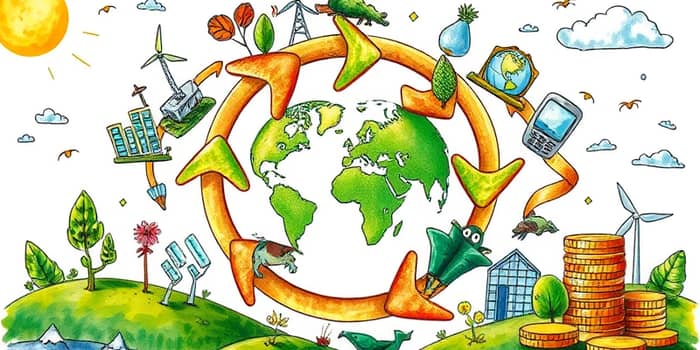
The transition from a linear “take-make-waste” model to a regenerative, circular economy is no longer an abstract ideal—it is a strategic necessity for businesses, governments, and investors worldwide. As resource constraints tighten and environmental risks mount, financing this transformation becomes critical.
By redefining how products are designed, produced, and circulated, the circular economy offers a pathway to eliminating waste, restoring ecosystems, and unlocking new growth. This article explores the financial mechanisms, policy frameworks, challenges, and opportunities that will drive the circular economy forward.
The circular economy represents a vast pool of untapped value. In Europe alone, it could generate an estimated €1.8 trillion per year in economic benefits through increased resource efficiency and new business models.
Private investment is surging: from 2010 to 2023, funding for recycling, repair, reuse, rental, and leasing activities rose by 36%, with gross value added climbing 15%. Public equity funds targeting circular initiatives grew tenfold between 2018 and 2020, while corporate and sovereign bonds with a circular focus expanded fivefold between 2019 and 2021.
Financial institutions have developed innovative tools to align capital flows with circular objectives. Sustainability-linked loans (SLLs) and bonds tie borrowing costs to performance against environmental targets.
For example, Tesco’s £2.5 billion SLL and Carrefour’s €1.5 billion sustainability-linked bond set ambitious food waste reduction goals, incentivizing companies to optimize supply chains and reduce losses.
To promote consistency, the Harmonized Circular Economy Finance Guidelines from the IFC define eligible activities and reference global taxonomies and Green Bond Principles, fostering market convergence and investor confidence.
Policy plays a pivotal role in steering financial flows. The EU’s Circular Economy Action Plan (CEAP) 2020 introduces measures across product lifecycles—from eco-design requirements to waste prevention strategies.
The EU Taxonomy now identifies circular transition as a core environmental objective, requiring companies to disclose the share of qualifying sustainable activities. Upcoming Ecodesign for Sustainable Products Regulations will further mobilize private capital by mandating product longevity, reparability, and recycled content.
At the international level, COP28 marked the first inclusion of circular economy principles in climate negotiation texts, underlining their importance for achieving net-zero climate targets and protecting biodiversity.
Financing strategies increasingly adopt a value chain approach, targeting interventions at different stages:
Upstream investments focus on product redesign, reducing virgin material use through modular electronics and biomaterials innovation. Midstream deals support sustainable manufacturing, lifecycle management, and remanufacturing in automotive and textile sectors. Downstream capital funds advanced recycling, waste-to-resource facilities, and collection infrastructure.
Major corporations now embed circular goals in financing structures, setting interim targets for 2025 and fostering collaboration with suppliers, recyclers, and technology providers.
Despite strong momentum, a significant funding shortfall remains. In 2024, annual circular economy investments in the EU totaled €141 billion, but the estimated need reached €170 billion—a gap of €29 billion (21% above baseline), with long-term requirements likely to grow further.
Bridging this gap demands scaled-up public–private partnerships, de-risking instruments, and targeted policy incentives to unlock capital for upstream design and systemic innovations.
The circular economy enhances business resilience by diversifying supply chains and reducing exposure to resource price volatility. Financial institutions benefit from lower portfolio risks and compliance costs, while companies gain innovation advantages and stronger stakeholder relationships.
Furthermore, circular models stimulate job creation in recycling, repair, and remanufacturing sectors, driving local economic growth and social inclusion. Market leaders view the transition as essential to tackling climate change, biodiversity loss, and systemic resource threats.
Numerous high-profile deals demonstrate the viability of circular financing:
These examples highlight how targeted financing instruments can drive measurable progress, foster innovation, and align corporate strategies with planetary boundaries.
The circular economy is more than an environmental imperative—it is a lucrative financial opportunity that strengthens businesses, communities, and ecosystems. By deploying the full spectrum of financing instruments, harmonizing global guidelines, and enacting supportive policies, stakeholders can close investment gaps and accelerate the shift to regenerative systems.
As capital flows increasingly reward sustainable practices, the circular economy will become a cornerstone of resilience, prosperity, and climate action. Now is the time for investors, policymakers, and businesses to collaborate, innovate, and finance the future of sustainability.
References