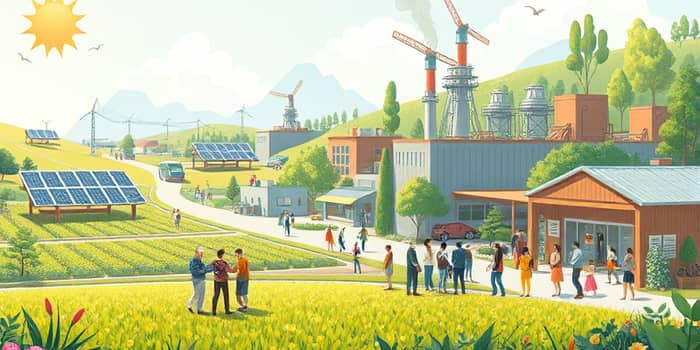
The circular economy represents a paradigm shift that decouples growth from resource use and environmental impact. By rethinking design, production, and consumption, it charts a path toward prosperity that respects ecological limits and regenerates natural systems.
At its core, the circular economy replaces the linear “take–make–use–dispose” model with systems designed to eliminate waste and pollution, keep products and materials in circulation at their highest value, and restore natural ecosystems. Rooted in ideas from the 1970s, this approach draws inspiration from nature’s cycles, where nothing is wasted and every output becomes an input.
The Ellen MacArthur Foundation frames it around three interlinked principles:
Similarly, the European Union emphasizes keeping products and materials in use for as long as possible, minimizing waste and resource consumption. The United Nations Environment Programme highlights the transformative power of reduction, reuse, refurbishment, and recycling to protect both people and the planet.
Practical strategies underpin the circular model, guiding businesses and communities to reimagine products, services, and supply chains. The 3R hierarchy often guides action:
Beyond this, circular design principles encourage teams to design to eliminate toxic substances, choose renewable or recycled inputs, and build for easy disassembly and upgrade. These practices not only reduce environmental burdens but also unlock innovation, lower costs, and foster customer loyalty through service-oriented models.
Investing in circular solutions yields compelling economic benefits at both macro and micro levels. For the European Union, circular strategies are central to achieving a more resilient and competitive Europe and reaching climate neutrality by 2050. Globally, they promise to decouple economic expansion from resource extraction.
At the business level, companies can realize significant savings by reducing input costs, minimizing waste processing fees, and mitigating commodity price volatility. New revenue streams emerge from product-as-a-service offerings, secondary markets for refurbished goods, and recovered material sales. Firms that adopt circular innovations often report leadership in market differentiation and supply chain resilience.
Moreover, these circular activities generate jobs across refurbishment, remanufacturing, recycling, and support services, creating local, place-based economic development and enhancing community resilience.
The urgency of resource constraints is stark: without change, we risk consuming materials at a rate that would require the equivalent of three planets by 2050. Circular approaches directly address this by prioritizing resource efficiency, reducing virgin extraction, and keeping materials in use.
By lowering demand for new resources and optimizing energy use, the circular model also reduces greenhouse gas emissions, helping nations meet ambitious climate targets. Regenerative practices, such as composting and agroforestry, restore soil health and biodiversity, while eliminating toxic substances from design leads to cleaner air, water, and land.
Beyond environmental and economic gains, circularity fosters social inclusion. By creating jobs in collection, repair shops, refurbishment centers, and sharing platforms, it offers pathways to employment for diverse skill levels. Communities engage in repair cafés, tool libraries, and community composting, strengthening social bonds and empowering citizens.
Service models improve access to essential goods—mobility, appliances, and tools—without the full burden of ownership costs. Public health benefits from reduced pollution and safer materials, especially in urban areas where waste mismanagement disproportionately affects vulnerable populations.
Governments and international bodies play a pivotal role in scaling circular solutions. The European Green Deal places circular economy action at its heart, with eco-design regulations, extended producer responsibility mandates, and sustainable product policies driving transformation. At the global level, the UNEP Finance Initiative calls on financial institutions to align capital flows with circular principles.
Public investment in research, education, and infrastructure accelerates innovation and facilitates the creation of robust secondary material markets. By embedding circular criteria into fiscal policy, governments can steer private capital toward sustainable projects and ensure that no one is left behind in the transition.
The circular economy is more than an environmental imperative—it is a blueprint for sustainable growth, social equity, and resilient communities. Every stakeholder has a role to play: businesses must rethink product lifecycles, investors should channel capital into circular ventures, policymakers need to enact supportive regulations, and consumers can embrace reuse and sharing.
By investing in circular solutions today, we not only safeguard natural resources and combat climate change but also build vibrant local economies, foster innovation, and strengthen social cohesion. The time for action is now: let us join forces to create a future where prosperity and the planet thrive in harmony.
References