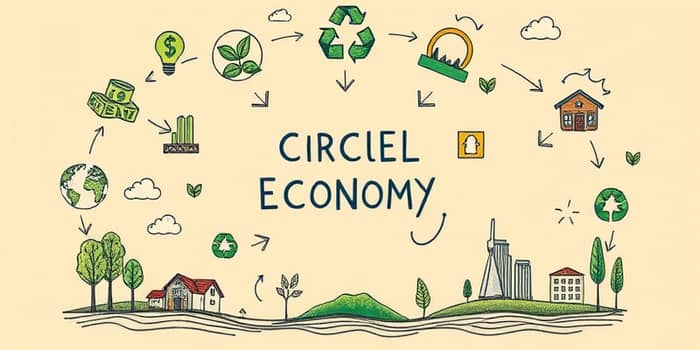
In a world grappling with resource depletion and environmental crises, a new economic paradigm is emerging, one that promises not just sustainability but regeneration.
This is the circular economy (CE), a model that challenges the outdated linear approach of take-make-dispose.
By emphasizing sharing, reusing, and recycling, it aims to extend product lifecycles and eliminate waste, paving the way for a healthier planet.
At its heart lies circular finance, a powerful tool that redirects capital to fuel this transformative shift, funding initiatives that regenerate rather than deplete.
Imagine an economy where growth is no longer tied to finite resources, but instead thrives on innovation and closed-loop systems.
This vision is not just idealistic; it is increasingly necessary as we face climate change and biodiversity loss.
Circular finance plays a pivotal role in making this vision a reality, offering practical solutions for investors, businesses, and communities alike.
The circular economy is built on three core principles that guide every aspect of production and consumption.
First, it focuses on designing out waste and pollution from the very beginning of product development.
Second, it emphasizes keeping products and materials in use for as long as possible through strategies like repair and refurbishment.
Third, it aims at regenerating natural systems, ensuring that economic activities restore rather than harm the environment.
This approach decouples economic growth from resource consumption, offering a stark contrast to the linear model that has dominated for centuries.
To operationalize these principles, the CE relies on seven key pillars that span across various action areas.
These pillars work together to create a holistic system that mimics nature's cycles.
Circular finance is the financial backbone that supports the circular economy, ensuring that money flows toward sustainable initiatives.
It includes any financial service or instrument, such as debt or equity, that is exclusively used to fund circular companies or projects.
Key elements in assessing circular finance involve evaluating the business model for circularity, measuring environmental and socio-economic impact, and excluding activities that lack genuine loops.
For instance, investments might be ring-fenced to specific circular activities like material recovery or resource optimization.
This targeted approach helps ensure that capital is effectively deployed to drive real change.
Several mechanisms enable circular finance to thrive in various contexts.
These tools empower stakeholders to participate in the transition toward a regenerative economy.
Adopting circular finance and economy models yields significant benefits across economic, environmental, and social dimensions.
Economically, it drives innovation and creates new jobs, while securing raw materials and reducing costs.
This decouples welfare from resource use, lowering dependence on foreign imports and enhancing resilience.
Environmentally, it cuts CO2 emissions, minimizes waste, and helps regenerate ecosystems, combating climate change.
Socially, it fosters sustainable societies through resource sharing and inclusive growth, improving quality of life.
At a corporate level, businesses gain climate resilience and extended product life, boosting long-term value.
However, the global picture remains challenging, with only 8.6% circularity reported in 2020, highlighting the urgent need for action.
This statistic underscores how overconsumption persists even in developed nations, calling for collective effort.
Circular business models are already demonstrating their potential in various sectors, showing how finance can enable practical change.
In the automotive industry, a shift toward sharing services reduces the number of cars per capita, saving materials and fuel.
Manufacturing embraces closed-loop systems where byproducts become inputs, coupled with renewable energy use.
These examples illustrate how circular principles translate into tangible outcomes, from resource savings to reduced pollution.
Key mechanisms include:
By funding such initiatives, circular finance catalyzes innovation and scales up impact.
This table highlights the stark differences, emphasizing why the transition is crucial.
Despite its promise, the circular economy faces several barriers that must be addressed to accelerate adoption.
Low recyclability of materials like certain plastics hampers progress, requiring technological advancements.
There is a pressing need for robust policy frameworks and increased collaboration among governments, businesses, and communities.
Transitioning from entrenched linear models is difficult, especially in high-consumption societies.
Financing gaps in emerging economies pose additional hurdles, limiting access to capital for circular projects.
However, these challenges also present opportunities for innovation and growth.
By tackling these issues head-on, we can unlock the full potential of a circular future.
Looking ahead, circular finance is poised to play a critical role in building a sustainable and regenerative economy.
It empowers us to move beyond mere efficiency toward restoration, where economic activities enrich the planet.
This requires a collective commitment from investors, policymakers, and individuals to prioritize circular investments.
By channeling funds into projects that eliminate waste and regenerate resources, we can create a legacy of resilience.
Imagine a world where every financial decision contributes to a healthier ecosystem, fostering abundance for generations.
Let us embrace this opportunity, using circular finance as a catalyst for positive change, and work together to fund a future that thrives in harmony with nature.
References