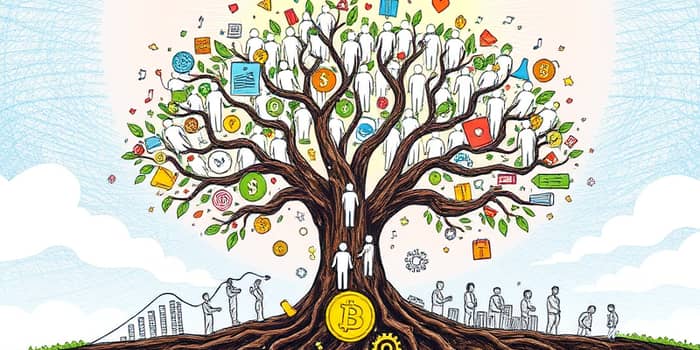
In an era of rapid change and mounting uncertainty, organizations that intentionally design for the long term can compound value, resilience, and impact. “Cultivating capital” means reinvesting across multiple dimensions of value—financial, human, digital, social, and organizational—to ensure sustainable growth beyond quarterly cycles.
Long-term growth depends on recognizing diverse forms of capital, each requiring tailored investment and stewardship. Shifting from an extractive approach that sacrifices future potential to a regenerative mindset is critical.
A compelling long-term strategy begins with a clear growth thesis and strategy that balances ambition with discipline. Embedding future-proofing elements—agility, automation, continuous learning—ensures adaptability to shocks and opportunities.
A balanced portfolio of growth initiatives prevents over-reliance on a single lever. Integrate data-driven decision making and customer insights with operational rigor to maximize returns on each investment.
Balancing financial discipline with growth ambition requires a robust allocation framework aligned to strategy and risk appetite. A well-structured approach ensures that reinvestment, expansion, and shareholder returns all contribute to compound value.
In a 2025 SMB survey, 54% of businesses cut operating costs, 54% raised prices, and 37% sought additional funding—demonstrating how cost discipline, pricing power, and strategic financing combine to preserve margins and enable future expansion.
Using debt and equity strategically means matching investment horizons to funding terms, maintaining credit flexibility, and avoiding overextension. Robust risk management is crucial in unsettled macro and geopolitical environments to sustain momentum through downturns.
People are the ultimate differentiator. The SHRM “4 P’s” framework positions human capital at the heart of strategy:
People, productivity, profitability, and prosperity align culture and capability with performance outcomes.
Organizations with HR aligned to business strategy are three times more likely to foster high-performing cultures. Core practices include:
Continuous learning is non-negotiable. A LinkedIn forecast predicts 70% of job skills will evolve by 2030. Embedding continuous learning is critical through tech-enabled platforms, education partnerships, and leadership engagement ensures human capital remains fresh and future-ready.
Operating models built on agility, data, and automation empower organizations to respond to rapid shifts. Key design principles include:
• Cloud-based platforms for scalable infrastructure
• Synchronous and asynchronous workflows to support distributed teams
• Automated processes for routine tasks to free capacity for strategic work
Near real-time visibility into spend and performance via integrated analytics tools transforms decision-making from reactive to proactive. Investing in these capabilities is a strategic choice that compounds through faster responses, fewer errors, and higher productivity.
Designing for long-term growth requires a holistic view of capital, strategy, and operations. By shifting from short-term extraction to a regenerative mindset, organizations can embed resilience, agility, and innovation into their DNA.
Practical steps include articulating a clear growth thesis, balancing a portfolio of strategic levers, allocating capital with discipline, investing relentlessly in people and technology, and continuously adapting through data and learning.
When leaders embrace “cultivating capital” as a guiding principle, they unlock the power to compound value for shareholders, employees, communities, and the planet—building truly enduring enterprises.
References