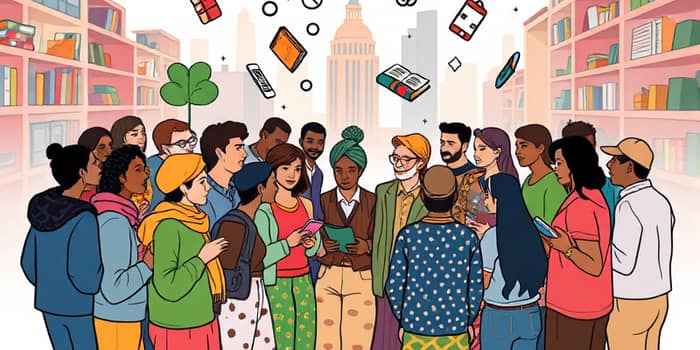
Imagine walking into a coffee shop and feeling a subtle pull towards the artisanal pour-over instead of the standard drip brew.
Cultural capital silently guides our choices, weaving social threads into every purchase we make.
It is the unseen force that transforms shopping from a mere transaction into a statement of identity and belonging.
This concept, rooted in sociology, reveals how our backgrounds shape what we buy and why.
Beyond income, it taps into deep-seated values and social cues that define consumer behavior globally.
Understanding it can empower us to make more mindful decisions and bridge cultural divides.
In a world where consumption is omnipresent, recognizing the influence of cultural capital can lead to greater empathy and insight.
Let's explore how this intangible asset drives our daily lives and connects us across continents.
At its core, cultural capital refers to non-financial social assets that influence status and opportunities.
These assets include knowledge, skills, education, and cultural tastes acquired through life experiences.
Pierre Bourdieu's framework categorizes cultural capital into three interconnected forms.
Together, these forms act as a social currency, shaping preferences beyond what money alone can explain.
They help individuals navigate complex social landscapes and signal belonging to specific groups.
This understanding is crucial for decoding consumer psychology in diverse markets.
Cultural capital operates through several key mechanisms that subtly guide consumer behavior.
It affects how we perceive value, making certain products seem prestigious or sophisticated.
For instance, awareness of trends and aesthetic appreciation drive early adoption of new styles.
The concept of habitus is central here, representing ingrained habits from social class.
Habitus filters our evaluation of goods, predisposing us to choices aligned with our background.
This occurs unconsciously, reinforcing social distinctions through everyday consumption.
Brand narratives also play a role, as cultural capital helps consumers connect with values and lifestyles.
Social signaling is another pathway, where purchases communicate status or group affiliation.
These mechanisms illustrate why two people might choose vastly different products, even with similar incomes.
Cultural capital manifests in tangible ways that we encounter daily, from coffee to clothing.
Consider the coffee example: one person buys a familiar supermarket brand based on price.
Another seeks specialty beans, understanding origin and brewing methods due to embodied capital.
Sustainable consumption habits often stem from cultural capital in environmental awareness.
Individuals might minimize waste or choose public transport as ingrained practices.
In fashion, preferences for artisanal or ethical brands reflect objectified and embodied capital.
These choices signal taste and alignment with specific cultural values.
Such examples make cultural capital relatable, showing its impact on personal and global scales.
Cultural capital is intertwined with power dynamics that can perpetuate social inequalities.
Marketplaces often privilege certain forms of capital, favoring luxury brands and exclusive appeals.
Advertising uses cultural codes that resonate more with specific groups, deepening divides.
The concept of cultural omnivorousness adds complexity, where appreciation for diverse forms becomes a marker of sophistication.
This creates new hierarchies based on breadth rather than just traditional high culture.
Systemic reproduction of inequalities occurs as consumption practices reinforce cultural hierarchies.
Understanding this helps us recognize and challenge unfair structures in consumer societies.
This table clarifies how each form operates, aiding in self-reflection and analysis.
Research reveals that cultural capital can reduce impulsive buying driven by psychological needs.
Individuals with higher cultural capital often exhibit greater rationality and self-control.
This leads to lower compensatory consumption, where purchases are made to fill emotional gaps.
Cultural capital improves non-cognitive abilities like confidence and emotional stability.
In contrast, low cultural capital may correlate with unclear self-concept and higher impulses.
Understanding this relationship can help consumers develop healthier spending habits.
It also offers insights for marketers targeting different audience segments effectively.
By building cultural capital, individuals can enhance their financial and emotional well-being.
Cultural capital is not static; it evolves with time and varies across communities globally.
What is valued in one culture may be irrelevant in another, highlighting its context-dependent nature.
In the digital age, online platforms reshape how cultural capital is accumulated and displayed.
Social media, for example, allows for new forms of signaling through curated content.
Global perspectives enrich our understanding of how cultural capital functions differently worldwide.
This dynamism is essential for adapting to changing consumer landscapes and fostering cross-cultural empathy.
Embracing this fluidity can inspire more inclusive and innovative approaches to consumption.
For consumers, recognizing cultural capital's influence can lead to more intentional choices.
It encourages reflection on why we buy certain things and how they align with our values.
Building cultural capital through learning and exposure can enhance decision-making skills.
For marketers, tailoring strategies to cultural capital levels can improve engagement and loyalty.
Target high cultural capital consumers with messages emphasizing sophistication and status.
Focus on brand identity and elite associations for those with lower cultural capital.
This approach respects diverse backgrounds while driving meaningful connections.
These tips offer actionable steps to navigate the complex interplay of culture and consumption.
By leveraging cultural capital, we can create more authentic and fulfilling consumer experiences.
Cultural capital is a powerful lens through which to view global consumer psychology.
It reminds us that our purchases are more than transactions; they are expressions of identity and connection.
Understanding its forms and mechanisms can inspire greater self-awareness and social harmony.
We can harness this knowledge to build more equitable and culturally rich societies.
Let's move forward with curiosity and empathy, recognizing the subtle forces that shape our world.
In doing so, we transform consumption from a routine act into a pathway for personal and collective growth.
References