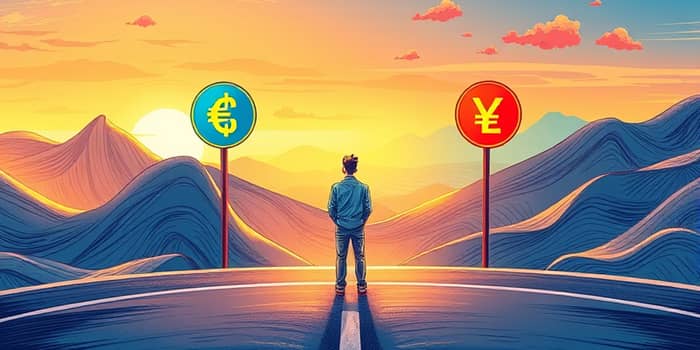
In today's interconnected world, navigating the twists and turns of international exchange rates is essential for anyone engaged in global finance.
Whether you're a traveler, investor, or business leader, understanding these rates can transform uncertainty into opportunity.
By grasping the fundamentals, you can make informed decisions that protect your assets and fuel growth.
At its core, an exchange rate represents the price at which one currency is traded for another.
For instance, a GBP/USD rate of 1.25 means that one British pound buys 1.25 US dollars.
This simple concept underpins everything from international trade to personal travel expenses.
Exchange rates are expressed as currency pairs and fluctuate constantly based on market dynamics.
There are several types of exchange rates that serve different purposes in the global economy.
Currency codes, such as USD or CAD, standardize these exchanges across borders.
Exchange rates are not random; they are shaped by a complex web of economic factors.
From inflation to geopolitical events, multiple drivers determine whether a currency strengthens or weakens.
Understanding these factors empowers you to anticipate changes and act proactively.
This table illustrates how interconnected factors like interest rates and inflation drive currency trends.
For example, when a country raises interest rates, it can draw in foreign investment, boosting its currency value.
Conversely, high government debt might signal inflation risk, leading to depreciation over time.
Countries adopt different exchange rate regimes based on their economic policies and goals.
Understanding these regimes helps in predicting currency behavior and planning strategically.
Historically, the focus has shifted from current account to capital account dominance post-financial liberalization.
This means investment flows now play a larger role than trade alone in determining exchange rates.
Exchange rates directly impact various aspects of personal and professional finance.
By leveraging this knowledge, you can make smarter choices in a globalized world.
Moreover, understanding purchasing power parity (PPP) helps assess if a currency is overvalued or undervalued.
PPP suggests that exchange rates adjust to equalize goods prices across countries in the long run.
This concept is implicit in the real exchange rate, which adjusts for price levels to reflect true purchasing power.
To truly master exchange rates, explore advanced topics that reveal underlying mechanics.
These concepts provide a richer understanding of global financial dynamics.
Parameters like substitution elasticity (θ=1.5) and home bias (γ=0.15) influence how economies respond to shocks.
By studying these elements, you can better navigate the complexities of global currency markets.
At the currency crossroads, preparation is key to turning challenges into opportunities.
Here are actionable strategies to help you thrive in a volatile environment.
Remember, exchange rates are influenced by both short-term shocks and long-term trends.
By focusing on fundamentals, you can make resilient decisions that withstand market ups and downs.
Mastering international exchange rates is more than a financial skill; it's a step toward global citizenship.
With the right knowledge, you can navigate this landscape confidently, transforming volatility into advantage.
Start today by educating yourself, applying practical tips, and staying adaptable to change.
The currency crossroads await—and with insight, you can chart a path to lasting financial success and empowerment.
References