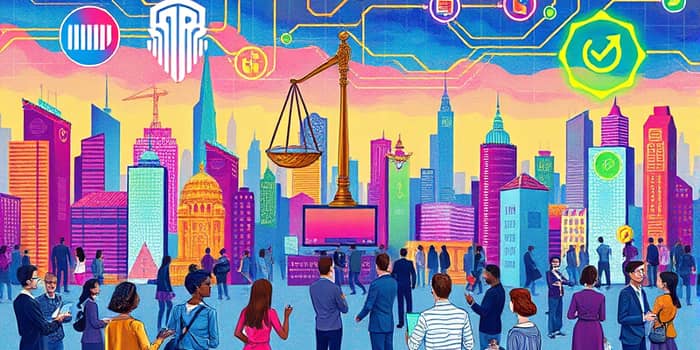
In 2026, the world stands at a pivotal crossroads where artificial intelligence is reshaping every facet of society, from business to ethics.
Trust in technology now hinges on embedding principles like transparency and fairness into every innovation.
This article explores how global standards are evolving and reveals the lucrative investment opportunities emerging from this ethical transformation.
By understanding these dynamics, we can navigate a future where AI not only drives progress but also upholds human values.
Ethical AI is no longer a niche concern but a mainstream imperative for businesses worldwide.
Standards emphasize transparency, fairness, accountability, and governance as foundational pillars.
These elements are critical for building public trust and ensuring responsible deployment.
As regulations fragment globally, companies must adapt to diverse frameworks while maintaining ethical consistency.
This shift marks a move from patchy progress to embedded business priorities by 2026.
Organizations that prioritize ethics are poised to gain competitive advantages and avoid costly pitfalls.
Several trends are defining the ethical AI landscape, each with profound implications for investors and innovators.
Transparency and Explainable AI is gaining urgency as opaque systems face scrutiny in high-stakes sectors.
Developers are pressured to solve the black box problem through auditable decision-making processes.
This is essential for applications in healthcare and finance where lives and economies are at stake.
Another critical trend involves copyright and creator compensation.
Ongoing court cases are pushing for clarity via opt-outs and revenue-sharing models.
These changes aim to balance innovation with fairness for content creators.
The regulatory landscape is fragmenting, with different approaches in the EU, UK, and US.
This diversity forces firms to navigate complex compliance requirements while fostering innovation.
Fairness, bias, and risk management are becoming integral to AI development.
Ethics frameworks must balance technological advancement with societal values to ensure accountability.
Sustainability and labor impacts are also in focus, as AI boosts ESG analysis but raises energy demands.
Strategies like carbon scheduling can turn this into a net-positive for emissions.
Cybersecurity threats are escalating, with AI enabling more sophisticated attacks.
This necessitates doubling cybersecurity spend and embedding AI-powered defenses.
To summarize, the key ethical AI trends for 2026 include:
Global efforts are converging to standardize ethical AI practices, offering a roadmap for responsible innovation.
Conferences like Corporate Governance & Ethics in AI 2026 are pivotal for discussing AI ethics and compliance.
These events cover topics from blockchain to IoT, emphasizing boardroom transparency.
Investor stewardship is intensifying, particularly in Europe, with a focus on climate adaptation and natural capital.
Initiatives like green bonds and debt-for-nature swaps are tripling investments by 2030.
This aligns with regulatory updates such as SFDR 2.0 and MiFID II, unlocking retail demand for ethical products.
Business predictions from firms like PwC highlight deliberate AI investments in high-payoff workflows.
WEF urges board-level cybersecurity and ethics governance to mitigate risks.
Expert consensus from Stanford and UC emphasizes ethical prioritization across all sectors.
AI is redefining responsible investing through enhanced ESG data and labor shift analyses.
Key global standards and initiatives include:
The ethical AI boom is unlocking unprecedented investment potential, driven by massive capital expenditures.
CapEx ramp-up is accelerating with tech giants investing over $300 billion in 2025, heading toward half a trillion soon.
This surge fuels earnings growth in the mid-20% range, outperforming the S&P 500's single digits.
Valuations with P/E ratios in the mid-20s are considered fair given the strong market moats.
Investment spans multiple sectors, each offering unique opportunities for ethical alignment and financial returns.
Below is a table highlighting key investment areas for 2026:
These sectors represent lucrative avenues for capital allocation that align with ethical principles.
Beyond traditional tech, sustainable AI focuses on environmental and social governance.
Natural capital is emerging as a new darling for investors seeking measurable impact.
Cybersecurity investments are critical as AI-powered threats necessitate advanced defense mechanisms.
Low-investment startups are also leveraging ethical AI for scalable solutions in governance tools.
Key investment strategies include:
Navigating the ethical AI landscape requires awareness of risks and disciplined strategies to harness opportunities.
AI bubble speculation in legal and tech sectors poses a threat, but success comes from transparent investments.
Disciplined approaches yield client efficiency and long-term returns, avoiding hype-driven pitfalls.
Ethics fault lines can shift capital toward useful cases that balance innovation with societal good.
Natural capital investments, for instance, offer triple growth by 2030 through initiatives like green bonds.
Cybersecurity must double in spending over two years to address AI-enabled attacks effectively.
Broader impacts include AI aiding sustainability, such as in disaster resilience and Scope 3 emissions tracking.
However, this demands deliberate use to avoid exacerbating energy and water demands.
Law firms emphasize strategic AI for tangible returns, not mere technological adoption.
Agent-driven enterprise scaling from 2025 onward will redefine operational efficiencies.
To mitigate risks and capitalize on opportunities, consider these strategies:
The journey toward ethical AI is both a moral imperative and a strategic advantage for 2026 and beyond.
By embracing standards like transparency and fairness, we can foster trust and drive inclusive growth.
Investment opportunities abound in sectors from semiconductors to sustainable tech, offering robust returns.
Global initiatives are paving the way for a harmonized approach to AI ethics and innovation.
As we move forward, let us champion responsible AI that uplifts humanity while unlocking economic potential.
Together, we can shape a future where technology serves as a force for good, guided by unwavering ethical principles.
References