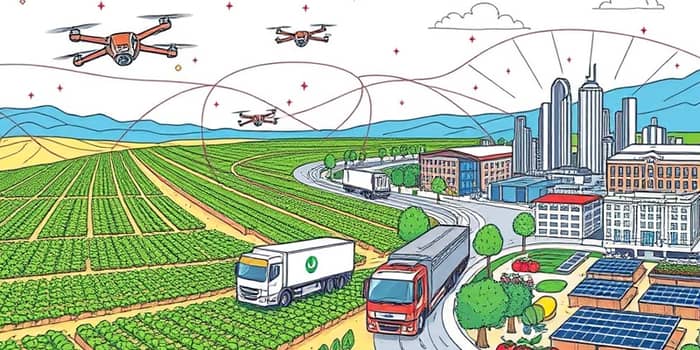
The journey from farm to market is no longer just about traditional agriculture. It is a dynamic ecosystem fueled by technology, sustainability, and global demand.
Global agribusiness as 10% of GDP underscores its critical role in economies worldwide. This sector is poised for unprecedented growth, with projections indicating a $10 trillion food and agriculture market by 2050.
Investors are recognizing the immense potential, channeling billions into innovations that enhance efficiency and resilience. From AgTech investments hit $29.6 billion to regenerative practices, the landscape is evolving rapidly.
The agribusiness market is set to expand by USD 843.4 million at a 4.6% CAGR from 2024 to 2029. Key segments like grains and cereals have shown steady growth, reaching USD 1,101.70 million in 2019.
This growth is driven by increasing populations and shifting consumer preferences. By 2034, global agriculture and fish production are expected to rise by 14%, highlighting the need for scalable solutions.
In 2023, AgTech investments soared to $29.6 billion, with trends pointing toward continued expansion. Timber and forestry vehicles: 62% of ag/forestry fund capital in H1 2025 demonstrates diversification.
Emerging areas include regenerative agriculture, which focuses on carbon credits and organic methods. Alternative proteins are gaining traction, with lab-grown meat projected to hit $25 billion by 2030 and $290 billion by 2035.
North America leads in AgTech venture capital, particularly in the U.S., where innovation thrives. Europe is advancing sustainable and organic practices, setting benchmarks for the world.
Asia-Pacific (49% market growth contribution) is a powerhouse, with its population expected to reach 4.44 billion by 2024. This drives investments in technology and food security initiatives.
Africa and Latin America are focusing on regenerative agriculture and supply chain improvements. These regions offer untapped opportunities for impact-driven investments.
As a proxy for global trends, U.S. farm economics reveal significant shifts. Net farm income forecast at $179.8B in 2025, marking a 40.7% increase from 2024.
Net cash income is projected at $180.7B, up 28.5%. Government payments have risen to $40.5B, largely due to disaster aid from acts like the American Relief Act 2025.
However, expenses are climbing to $467.4B, a 2.6% increase. Crop receipts have declined to $236.6B, reflecting market volatilities.
The World Bank's agricultural price index fell by 7% in Q2 2025, signaling broader economic pressures. Falling commodity prices coupled with weakening global growth in emerging markets, at 3.8% in 2025-2026, pose risks.
Climate change introduces volatility, with extreme weather disrupting production. Regulations and trade barriers add complexity, slowing growth in key regions.
Major corporations are at the forefront of this transformation. Top giants: Bayer ($11,613M revenue) and Corteva ($9,472M revenue) lead with research and development.
Syngenta and other players invest heavily in biotech and precision agriculture. Their efforts are crucial for scaling innovations and meeting global food demands.
These companies collaborate with startups to integrate new technologies. This synergy accelerates the adoption of sustainable practices across the supply chain.
Various avenues exist for investors to participate in agri-business. Venture capital and private equity are prominent, funding high-growth startups in AgTech and beyond.
Government and institutional support, through subsidies and R&D funding, plays a vital role. Government payments up to $40.5B in the U.S. highlight this trend.
Crowdfunding and impact investing, via platforms like Kiva, enable grassroots participation. ESG criteria are increasingly guiding investment decisions, aligning profits with purpose.
Automation and robotics are becoming mainstream, reducing labor costs and enhancing precision. Automation and robotics mainstream integration will redefine farming efficiency.
ESG considerations are driving growth, with investors prioritizing environmental and social impacts. Emerging markets in Africa and Southeast Asia offer fertile ground for expansion.
Tensions between affordability, performance, and sustainability will shape future strategies. Innovations in nutrition and local food systems will cater to evolving consumer preferences.
The future of agri-business is bright, with investments paving the way for a more resilient and equitable food system. By embracing innovation and sustainability, we can ensure that the journey from farm to market nourishes both people and the planet.
References