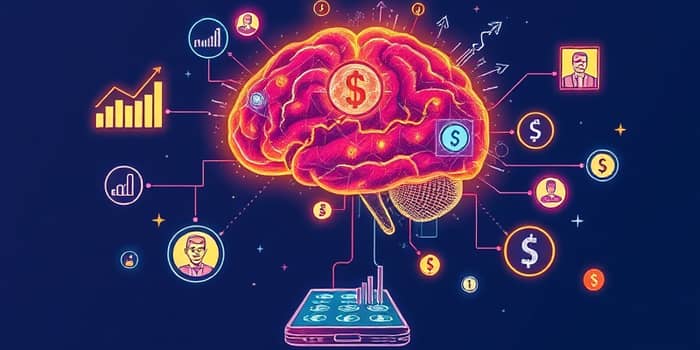
In the dynamic world of finance, the quest for personalized guidance has often been hindered by scalability limitations.
Generative AI emerges as a transformative force, enabling hyper-personalized financial advice that was once a distant dream.
By analyzing vast customer data like transaction history, it crafts tailored insights and strategies for every individual.
This shift is revolutionizing how we manage wealth, bank, and insure our futures.
No longer bound by generic solutions, AI-driven personalization brings a new era of financial empowerment.
Imagine receiving investment tips that reflect your exact goals and risk tolerance, all at your fingertips.
Generative AI makes this possible by sifting through behavior patterns and market trends in real-time.
It's not just about automation; it's about creating meaningful, individualized interactions that scale globally.
As we approach 2026, this technology is set to become a core part of financial infrastructure.
The journey from pilots to widespread adoption marks a pivotal moment for enterprises and consumers alike.
Generative AI leverages large language models to provide tailored insights and recommendations that adapt to each user's unique circumstances.
This goes beyond simple data analysis; it involves generating portfolio summaries and interactive advice that feels personal.
Financial institutions are embedding these AI systems into front-office tools for enhanced customer engagement.
Middle and back-office processes also benefit, with automation speeding up tasks like compliance and fraud detection.
The result is a seamless blend of human expertise and AI-powered decision support that elevates the entire financial ecosystem.
This evolution is driven by the ability to process unstructured data, such as market reports and customer feedback.
By 2026, we expect to see AI deeply integrated into workflows, from voice assistants to predictive analytics.
The promise is clear: financial advice that is not only personalized but also accessible and efficient.
Generative AI is already making waves across various sectors, offering practical solutions that enhance user experience.
Here are some specific applications where it shines:
These use cases demonstrate how AI moves beyond generic tools to offer depth and relevance.
Each application is designed to scale, ensuring that personalized advice reaches millions without compromising quality.
To deliver hyper-personalized advice at scale, Generative AI relies on several key mechanisms that enhance its reach and effectiveness.
Automation is at the forefront, handling high-volume tasks like loan approvals and fraud analysis with speed.
Data integration connects AI to unified customer histories, enabling context-aware responses and personalized advice based on behavior patterns.
Multi-channel delivery ensures that insights are accessible via apps, chat, voice, and advisors, catering to diverse user preferences.
The human-AI hybrid model uses copilots to augment advisors, allowing them to focus on complex judgment calls while AI handles routine summaries.
By 2026, these mechanisms will evolve into operational infrastructure, embedding AI deeply into everyday financial workflows.
This scaling is not just about technology; it's about reimagining processes to be more efficient and user-centric.
This table illustrates how each factor contributes to scaling personalized financial advice effectively.
Together, they ensure that AI can operate at enterprise levels, transforming how services are delivered.
While Generative AI offers immense potential, it comes with challenges that require careful management to ensure trust and safety.
Explainability issues arise as AI models often lack clear decision paths, posing audit challenges and compliance risks in regulated environments.
Data security and fraud exposure are critical concerns, with personalization relying on sensitive customer information.
Bias in AI algorithms can lead to unfair recommendations, highlighting the need for responsible AI practices.
To address these, strong governance frameworks are essential, incorporating human oversight and audit trails.
By proactively managing these challenges, financial institutions can harness AI's power while maintaining integrity.
The goal is to create a balanced ecosystem where innovation thrives without compromising on security or fairness.
Generative AI delivers tangible benefits that drive efficiency, enhance customer experience, and improve risk management.
By 2026, it is projected to shift from pilots to core technology, with a growing majority of banks expanding applications.
The outcomes span various categories, offering measurable improvements in financial operations.
Industry examples show how institutions like Morgan Stanley and Bank of America are already leveraging AI for internal summaries and tools.
Fidelity's evolution of advisor tools demonstrates the practical impact on wealth management services.
Looking ahead, Generative AI will converge with digital employees and voice AI, creating co-bots and suggestion engines that deepen advice.
This is not just about tools; it's about transforming the very nature of financial interactions, making them more human-centric.
The future promises a world where AI augments our financial decisions, offering personalized guidance that scales effortlessly.
Embrace this change by exploring AI-driven solutions and advocating for ethical practices in your financial journey.
References