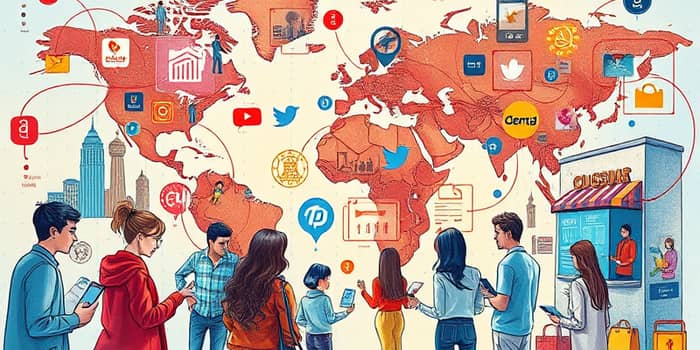
In today’s rapidly evolving economy, brand power has leaped from marketing collateral into the core of corporate valuation and national strategy. As consumers become more discerning, their loyalty drives long-term growth and resilience. Understanding how global brands accumulate, protect, and expand that loyalty is critical for executives, investors, and policymakers alike.
This article explores the macro forces behind brand value, highlights leading companies and regions, and offers practical guidance on harnessing consumer trust to maximize intangible asset performance.
Global brand value reached unprecedented levels in 2025. The combined worth of the top 5,000 brands surpassed USD 14 trillion, a jump of nearly 6% from the prior year. This figure sits more than USD 3 trillion above 2020’s total, underscoring the soaring significance of intangibles in the modern economy.
Within that total, the 500 most valuable brands are now worth USD 9.5 trillion, growing at 10% year-on-year—outpacing global economic expansion by more than threefold. The concentration is stark: over 80% of total brand value is held by fewer than 30 behemoths, reshaping competitive dynamics and investor portfolios everywhere.
As intangible assets rise, so does their influence on corporate strategy. Organizations that champion intangible assets driving economic growth find themselves better positioned to weather disruptions and deliver sustained stakeholder returns.
Three major valuation systems—Kantar BrandZ, Brand Finance, and Interbrand—offer complementary views on brand worth. Despite methodological differences, they converge on a familiar roster of leaders, dominated by technology and platform businesses.
Apple retains its crown with a Kantar value exceeding USD 1.3 trillion, while Google and Microsoft follow at USD 944 billion and USD 713 billion respectively. Amazon and NVIDIA round out the top five, with NVIDIA marking the fastest brand value surge of over 100% year-on-year.
Beyond purely financial metrics, brand strength indexes place WeChat, Nike, and Google at the pinnacle of consumer loyalty, reputation, and stakeholder confidence. These companies exemplify how strategic investment in consumer loyalty programs can reinforce market leadership.
The United States leads global branding by a wide margin, contributing USD 6.41 trillion—nearly 46% of the top 5,000 brands’ combined value. That total exceeds the brand value of the next fifteen economies combined and equates to 21.1% of US GDP when scaled for economic size.
China follows with USD 1.81 trillion, supported by TikTok, WeChat, and other digital champions. Japan, Germany, France, and the United Kingdom occupy subsequent positions, collectively illustrating how nations that cultivate brand ecosystems gain cultural influence and export power.
When evaluated as a percentage of GDP, Sweden (19.0%), Switzerland (18.8%), and France (18.1%) demonstrate that smaller economies can punch above their weight by nurturing brand-related innovation, intellectual property, and marketing infrastructures.
Brand assessments hinge on three intertwined concepts: brand value, brand equity, and brand strength. Each sheds light on a different dimension of consumer loyalty and corporate worth.
Brand value quantifies how much a brand contributes to future cash flows, factoring in premium pricing and market share gains. Brand equity reflects consumer perceptions—awareness, preference, satisfaction, and advocacy—gauged through surveys of millions of participants across thousands of categories. Brand strength evaluates the durability of those perceptions via governance, innovation pipelines, and stakeholder engagement.
Brands that endure and expand their influence adopt a multifaceted approach. They invest in comprehensive customer insights, deploy agile omnichannel experiences, and foster emotional connections through storytelling. The era of one-size-fits-all messaging has given way to hyper-personalized journeys.
Key tactics include:
By integrating these elements, companies build long-term consumer engagement and advocacy that not only protects market share but also invites premium valuation from investors.
Quantitative analysis confirms that brands with robust loyalty metrics deliver superior financial performance. Premium pricing power, repeat purchase rates, and referral-driven growth combine to boost revenue stability and profit margins. For investors, this translates into more predictable earnings and higher multiples.
At the macro level, a strong brand portfolio contributes to national competitiveness through brand-driven influence, attracting foreign investment and supporting high-value exports. Governments and industry bodies are increasingly recognizing brand development as a pillar of economic policy.
These figures highlight slight methodological variances but reinforce a clear narrative: tech and platform brands dominate global rankings, driven by innovation and user loyalty.
In a landscape where competition intensifies and consumer attention spans dwindle, investing in loyalty emerges as both a defensive shield and a growth engine. By aligning purpose, experience, and value, global brands can secure their place at the forefront of economic progress and cultural influence.
References