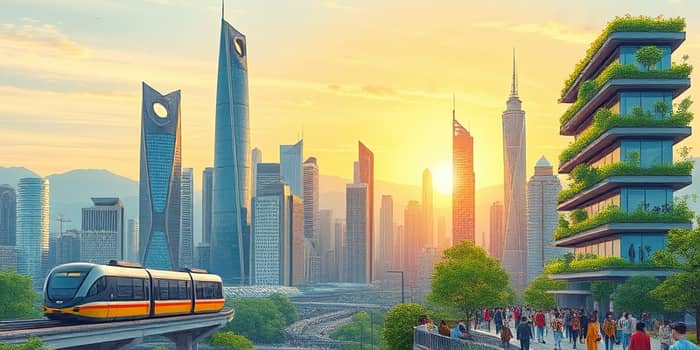
The dawn of the 21st century has ushered in an unprecedented wave of urbanization, transforming our planet's landscape in profound ways.
Megacities, defined as urban agglomerations with over 10 million residents, are at the forefront of this dramatic shift.
From just 8 in 1975 to 33 in 2025, the number has seen a quadrupling in growth, signaling a new era of human concentration.
This rapid expansion is not merely a demographic trend but a catalyst for economic and social change globally.
Investors who understand this dynamic can unlock lucrative opportunities while contributing to sustainable development.
Urbanization is accelerating at a breathtaking pace across the globe.
Today, 58% of the world's population resides in cities, a figure projected to rise to 67% by 2050.
This movement is driven by factors such as economic opportunities, technological advancements, and rural-to-urban migration.
Key statistics highlight the scale of this transformation.
Understanding these trends is crucial for anyone looking to navigate the future of global markets.
To grasp the urban landscape, one must look at the leading megacities that shape our world.
These cities are not just population hubs but economic powerhouses with unique growth trajectories.
The table below presents the top megacities based on 2025 estimates, though data discrepancies exist due to varying methodologies like urban agglomeration versus city proper boundaries.
Note that populations can vary; for instance, Jakarta's figures range up to 42 million depending on the source.
This dynamic and evolving ranking highlights the fluid nature of urban development and the need for up-to-date data.
Investors must consider these nuances when assessing opportunities in different regions.
Asia stands as the epicenter of megacity growth, with 19 out of 33 located there, reflecting its economic rise.
Latin America and Africa are also significant players, with cities like Sao Paulo and Cairo making the list.
These regions offer diverse investment landscapes due to varying growth rates and developmental stages.
By focusing on these hotspots, investors can tap into high-growth areas with less saturation.
Looking ahead, the urbanization trend shows no signs of slowing down.
By 2050, the number of megacities is expected to rise to 37, with Dhaka projected to become the largest at 51.1 million inhabitants.
This growth will reshape global demographics and economic patterns in profound ways.
Investors who anticipate these changes can position themselves at the forefront of urban innovation.
With rapid urbanization comes a wealth of investment avenues that can yield significant returns.
Megacities demand solutions for housing, transportation, and sustainability, creating fertile ground for innovation.
Key areas for investment include:
This diverse and expanding investment landscape allows for risk diversification and long-term growth.
By focusing on these sectors, investors can contribute to creating livable, resilient cities.
Rapid urbanization is not without its hurdles, which must be addressed to ensure sustainable growth.
Overcrowding, resource strain, and infrastructure deficits are common issues in many megacities.
However, these challenges also present opportunities for innovative solutions and collaborative efforts.
Overcoming these obstacles requires innovative approaches and global cooperation, making it a key area for investment.
Investors can play a pivotal role by funding projects that tackle these issues head-on.
The era of megacities is here to stay, offering a golden opportunity for those ready to engage with urban futures.
By investing in infrastructure, sustainability, and technology, we can build cities that are not only economically vibrant but also socially inclusive and environmentally sound.
The future is undeniably urban, and with strategic and mindful investments, we can shape it for the better.
Embrace this transformative wave and be part of the solution that defines the next century of human habitation.
References