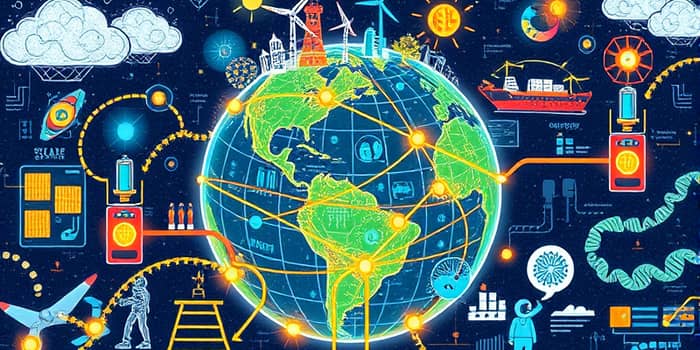
As we stride into 2026, the world is poised on the brink of transformation. From power grids humming with renewable energy to AI agents reshaping work, these trends herald an era of innovation and resilience.
Over the past decade, China has methodically built strengths in sectors once led by Western powers. Its rapid gains in smartphones, shipbuilding, batteries, solar panels, electric vehicles, and drones highlight a relentless march toward global leadership.
By 2026, China is set to challenge industry titans in space exploration, advanced semiconductors, and biopharmaceuticals. While obstacles remain—such as large commercial aircraft—Beijing’s “flying geese” strategy is breaking regional supply chains and prompting countermeasures like tariffs on steel and car imports.
Investors and businesses must adapt to this shift, recognizing China not as a fleeting rival but as a formidable long-term competitor.
The AI revolution shows no signs of slowing. Fueled by massive capital expenditure and breakthrough models, artificial intelligence has become a driving force across industries. J.P. Morgan forecasts double-digit equity gains in global markets as companies harness AI to optimize operations and innovate at scale.
Key sub-trends include:
As data centers consume an ever-growing share of power—projected to rise from 3% to 8% of U.S. electricity by 2030—ethical AI and robust cognitive infrastructure become urgent priorities.
Geopolitical tensions, tariffs, and the energy demands of AI have spurred nations to reassess supply chains. The focus has shifted from pure cost efficiency to a balance of flexibility and risk mitigation. The reindustrialization wave in the U.S. and EU involves:
By securing critical materials—rare earths, semiconductors, and clean energy resources—countries can build robust economic security measures and guard against future disruptions.
The green revolution shows no signs of abating. In 2025, solar and wind installations grew by over 17%, while fossil fuel demand held nearly flat. As AI consumption soars, renewables, grid modernization, and energy storage projects are prioritized over slower hydrogen and carbon capture ventures.
Emerging experiments in ambient noise harvesting and early fusion concepts hint at a future beyond conventional power sources. Yet water stress remains a looming challenge—one-third of thermal plants and two-thirds of new data centers lie in high-stress regions.
Corporate climate adaptation plans rose to 42% in 2025, reflecting an unwavering commitment to sustainability and resilience against droughts, heat waves, and other climate shocks.
Advances in biotech and healthtech are extending lives and improving daily experiences. From GLP-1 therapies and genomics-driven precision medicine to telehealth platforms and wearable monitors, technology is personalizing care like never before.
Breakthroughs include:
These innovations promise a transformative power of longevity solutions, creating new markets and enhancing overall well-being for aging populations worldwide.
Beyond the headline trends, a wave of cross-industry innovations is reshaping our future. In transportation, software-defined vehicles adapt to user preferences in real time. Indoor and vertical farming facilities use robotics and AI to maximize yields with minimal land use. Cybersecurity infrastructures evolve to counter distributed threats, while cloud platforms scale to meet unprecedented data needs.
Analysts identify the emergence of four new economic classes driven by technology access, underscoring the importance of inclusive policies and investment strategies that bridge digital divides.
For investors seeking long-term returns, the following areas stand out:
While recession risks linger at roughly 35%, positive equity momentum from AI and earnings growth offers compelling opportunities for disciplined investors.
No megatrend is without peril. Mounting debt pressures, inflation persistence, water and labor shortages, and potential geopolitical flashpoints—such as tariff escalations or a blockade in Taiwan—could strain global growth and derail key projects.
Maintaining flexibility, diversifying exposures, and prioritizing strategic scenario planning and resilience will be essential as stakeholders navigate this complex landscape.
As we chart the course for long-term value in 2026 and beyond, these interconnected megatrends offer both challenges and transformative potential. By understanding their dynamics and aligning resources accordingly, businesses, investors, and policymakers can turn disruption into opportunity and build a more prosperous, sustainable future.
References