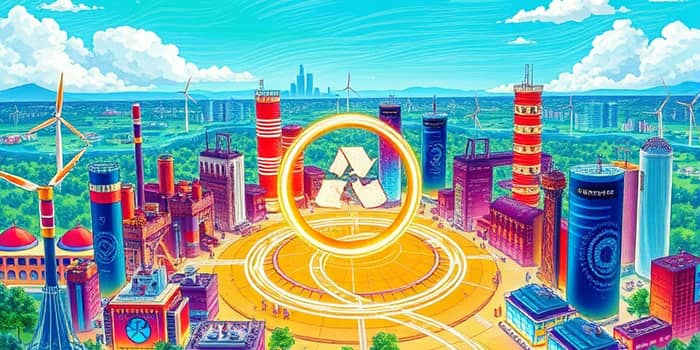
In a world grappling with environmental crises, the circular economy emerges as a beacon of hope, shifting from a linear take-make-dispose model to one that designs out waste and pollution.
This transformative approach emphasizes reuse, repair, and regeneration, creating a sustainable lifecycle for materials that aligns with global goals like the Paris Agreement.
By focusing on resource efficiency, we can unlock economic benefits while safeguarding our planet for future generations, making this an urgent and inspiring journey.
At its heart, the circular economy is built on principles that prioritize longevity and sustainability.
It involves extracting maximum value from resources through strategies like recycling and refurbishment.
Key elements include reducing material footprints and integrating with broader sustainability targets.
These principles drive innovation across industries, fostering a resilient and eco-friendly economy.
The need for change is underscored by staggering data on global resource use.
Current trends show unsustainable growth that demands immediate action.
These figures reveal a critical gap between current practices and sustainable targets.
For instance, the per capita footprint equates to 2.5 African elephants annually, highlighting the massive resource consumption we must address.
Adopting circular models offers substantial financial advantages, driving growth and stability.
Potential benefits include trillions in savings and new revenue streams from innovative business models.
This economic shift not only boosts profits but also creates jobs and fosters innovation.
Several factors are accelerating the transition to a circular economy, making it a strategic imperative.
Material scarcity, especially for critical minerals, pushes companies to recover and reuse assets.
Regulations worldwide are mandating changes, with policies like the EU Circular Economy Act setting ambitious targets.
These drivers ensure that circularity becomes a core part of business and governmental agendas.
Innovations in technology are pivotal for enabling circular practices and scaling solutions.
AI and digital tools, for example, enhance sorting and maintenance, boosting efficiency dramatically.
These technologies reduce contamination and emissions, making circular processes more viable and effective.
Across various industries, circular models are already delivering tangible results and inspiring change.
In manufacturing, cloud systems enable digital product passports and improve resource tracking.
The refurbished phone market is booming, driven by circular repairs and resale strategies.
These examples show how circular principles can be applied creatively to achieve sustainability goals.
Despite progress, significant hurdles remain that require concerted efforts and innovative solutions.
Infrastructure gaps, such as inadequate recycling plants, hinder widespread adoption in many regions.
Collection inefficiencies are particularly acute in low-income areas, limiting access to circular benefits.
Addressing these obstacles is essential for unlocking the full potential of the circular economy.
To embrace circularity, practical steps can guide you toward meaningful impact and innovation.
Start by investigating technologies like IoT and AI to optimize operations and reduce waste.
Integrate systems such as ERP for better waste insights and logistics management.
These actions empower you to contribute to a sustainable future while gaining economic advantages.
The circular economy is poised for exponential growth, driven by laws, technology, and scarcity.
By 2026, priorities will shift towards execution over preparation, with circularity becoming a key ROI driver.
Potential breakthroughs include enhanced supply chain resilience and integration with clean energy foundations.
This optimistic outlook encourages proactive engagement, offering a path to a thriving and sustainable world.
References