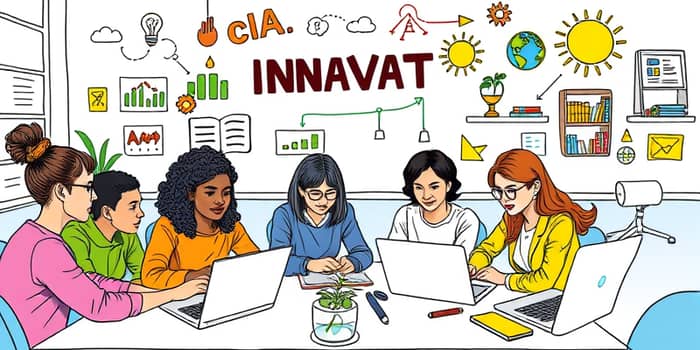
In today's rapidly evolving world, social entrepreneurs are stepping up to address pressing challenges with creativity and resilience.
Innovation labs and accelerators serve as vital catalysts, transforming bold visions into actionable, sustainable solutions.
The global accelerator market is experiencing significant expansion, driven by increasing investment in ventures that blend profit with purpose.
This growth trajectory offers unprecedented opportunities for those aiming to make a meaningful impact.
By providing structured support, these programs empower startups to scale their ideas and create lasting change.
The startup accelerator market is projected to grow from $5.11 billion in 2025 to $6.07 billion in 2026.
This surge highlights a global commitment to nurturing early-stage ventures across various sectors.
Social startups, in particular, are benefiting from this momentum, gaining access to resources previously reserved for traditional businesses.
The rise of innovation hubs reflects a broader shift towards mission-driven entrepreneurship.
These environments foster collaboration, experimentation, and rapid iteration to tackle complex societal issues.
As a result, aspiring changemakers can now find tailored support to amplify their efforts.
Major accelerators like Y Combinator and MassChallenge are increasingly supporting social enterprises alongside commercial startups.
Y Combinator, based in California, has made over 4,000 investments, typically providing $500,000 to software and IT ventures.
MassChallenge, from Massachusetts, focuses on sectors like healthcare and has facilitated more than 240 exits.
These programs offer intensive mentorship and coaching, helping founders refine their models and secure funding.
By integrating social impact into their portfolios, they bridge the gap between innovation and real-world application.
This dual focus ensures that startups can achieve both financial viability and societal benefit.
This table highlights the diversity of support available, from funding to sector-specific guidance.
Understanding these options can help social startups choose the right path for their unique goals.
Specialized accelerators like Seed Spot and gBETA Social Impact are designed exclusively for mission-driven ventures.
Seed Spot offers an 8-week program aimed at driving rapid revenue growth and enhancing investment readiness.
Participants gain lifelong access to a network of mentors and industry leaders, fostering continuous learning.
gBETA Social Impact provides a free, virtual accelerator focused on equity in education and criminal justice reform.
This seven-week program includes personalized coaching and access to over $1 million in vendor perks.
Such initiatives demonstrate a commitment to removing barriers for early-stage social entrepreneurs.
SEA Change further expands this support with free 16-week cohorts and online modules, building a national affiliate network.
These dedicated programs ensure that founders receive the tools and community needed to thrive.
This list showcases the variety of models available, from equity-free to direct investment approaches.
Each program tailors its support to address specific challenges faced by social startups.
Social impact accelerators concentrate on diverse fields that are critical to global well-being.
Healthcare and HealthTech innovations are tackling access and affordability issues in underserved communities.
Education and EdTech startups are revolutionizing learning methods to promote equity and inclusion.
Climate and renewable energy ventures are addressing environmental sustainability through innovative solutions.
Financial inclusion and fintech efforts are empowering marginalized groups with better economic opportunities.
Criminal justice reform initiatives are working to create fairer systems and reduce disparities.
Advanced manufacturing and environmental sustainability projects are fostering green economies and job creation.
Focusing on these sectors allows accelerators to target areas with high potential for societal impact.
Startups in these fields can leverage specialized knowledge and networks to accelerate their growth.
Accelerator programs typically last between 7 to 16 weeks, offering intensive, time-bound support.
Funding ranges from free resources and equity-free models to investments exceeding $250,000 per company.
This flexibility ensures that startups at different stages can find appropriate financial backing.
Support includes mentorship, investor introductions, and access to corporate partners like IBM and Microsoft.
Office space, fundraising preparation, and pitch opportunities are commonly provided to enhance readiness.
Alumni networks offer lifetime benefits, fostering ongoing collaboration and growth.
These elements combine to create a comprehensive ecosystem that nurtures innovation from idea to impact.
Understanding this structure helps entrepreneurs maximize their participation in accelerator programs.
By leveraging these resources, startups can build solid foundations for long-term success.
Accelerators are concentrated in key regions like California, New York, and Massachusetts, but their reach is expanding.
Programs exist across 28 states, including regional initiatives in Colorado, Texas, and Pennsylvania.
This geographic distribution enables social startups to access support regardless of location.
Virtual accelerators are further democratizing access, allowing participants to engage from anywhere.
National affiliate networks, such as those run by SEA Change, facilitate distributed support and collaboration.
This widespread presence ensures that innovative ideas can emerge from diverse communities and contexts.
This list highlights the strategic locations where accelerators are making a significant impact.
Aspiring entrepreneurs should explore options in their regions to find the best fit for their needs.
Notable alumni from programs like StartX include companies such as Lumos and Patreon, which have scaled globally.
Capital Innovators in St. Louis has supported over 150 companies, with alumni raising more than $400 million.
Founding To Give has aided 43 organizations across 28 states, collectively reaching over 250,000 young people.
These success stories demonstrate the transformative power of accelerator support in driving social change.
Startups that graduate from these programs often secure significant funding and expand their impact.
By learning from these examples, new entrepreneurs can envision their own paths to success.
The broader startup ecosystem includes over 75,000 startups within major accelerator networks.
Leading programs have made more than 1,600 investments, with annual revenues exceeding $70 million in some cases.
Access to corporate partnerships with tech giants provides additional resources and credibility.
This robust ecosystem ensures that social startups have the financial and strategic backing to thrive.
Investors are increasingly prioritizing mission-aligned ventures that offer both financial and social returns.
This shift is creating more opportunities for startups to secure the capital needed for growth.
Free and equity-free models are gaining prominence, making acceleration accessible to more founders.
Virtual accelerators are expanding beyond geographic constraints, enabling global participation.
Sector-specific focus on areas like healthcare and climate is driving targeted innovation.
National affiliate networks are facilitating distributed support across multiple regions.
Direct venture capital models combine acceleration with investment, streamlining the funding process.
Mission-aligned funding emphasizes dual returns, encouraging more investors to back social ventures.
These trends indicate a future where social entrepreneurship is more inclusive, scalable, and impactful.
By staying informed, startups can adapt to these changes and leverage new opportunities.
Begin by identifying your core mission and the social issue you aim to address.
Research accelerators that align with your sector, such as those focusing on healthcare or education.
Prepare a compelling application that highlights your impact potential and business model.
Leverage networking opportunities within accelerator programs to build relationships with mentors and investors.
Utilize the resources provided, from coaching to pitch sessions, to refine your strategy and scale your venture.
Stay engaged with alumni networks to continue learning and collaborating post-program.
By following these steps, you can navigate the accelerator landscape effectively and maximize your chances of success.
Remember, the journey of social innovation is challenging but immensely rewarding, with the potential to create lasting positive change.
References