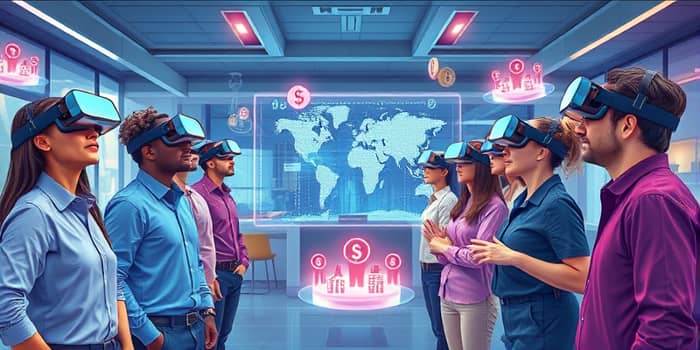
The dawn of the metaverse economy heralds a transformative era where digital and physical realities converge, creating new financial realms and opportunities for all.
As virtual worlds expand, they bring with them a burgeoning market set to redefine global economics, with projections reaching trillions of dollars by the next decade.
This is not merely a technological shift but a fundamental reimagining of how we interact, trade, and build wealth in an increasingly interconnected universe.
The metaverse is poised to become an integral part of daily life, offering immersive experiences that go beyond entertainment.
The metaverse industry is witnessing unprecedented expansion, with valuations skyrocketing in recent years.
In 2023, the industry was valued between $82 billion and $95 billion, showcasing its rapid ascent from niche to mainstream.
By 2025, this figure had ballooned to approximately $155.35 billion, indicating a robust upward trajectory.
Looking ahead, forecasts are staggering: the market is expected to reach around $1.3 trillion by 2032 and could soar to $7,171.54 billion by 2035.
Some earlier estimates, such as one from McKinsey, even projected a $5 trillion market by 2030, highlighting the optimistic sentiment surrounding this space.
Key growth drivers include:
User adoption is accelerating, with 25% of people predicted to spend at least one hour daily in the metaverse by 2026 for various activities.
Moreover, 30% of organizations are expected to have metaverse-ready products and services by the same year, signaling corporate embrace.
At the heart of the metaverse economy lie virtual assets, which are set to dominate growth by 2030.
These assets represent new forms of value and ownership in digital spaces.
The primary categories include:
These assets are not just digital novelties; they are becoming integral to economic activities, from commerce to entertainment.
Several trends are fueling the metaverse economy's rise, transforming traditional sectors.
Virtual commerce is revolutionizing retail, with VR shopping experiences offering immersive alternatives to e-commerce.
Brands are investing heavily in permanent metaverse presences, bridging digital and physical sales channels.
Digital real estate has emerged as a lucrative market, with companies and investors purchasing virtual land for various purposes.
Interoperable avatars and digital identities allow users to move seamlessly between virtual worlds, boosting interaction and economic flow.
Tokenized assets provide proof of ownership that's easy to transfer, while enterprise infrastructure is being built by tech giants to attract institutional players.
The marketplace structure is evolving into niche verticals, such as creator marketplaces, digital branding shops, and enterprise solutions.
Web3 commerce introduces innovative monetization strategies that enhance user engagement and revenue streams.
These models are designed to cater to diverse consumer preferences and spending habits.
This flexibility encourages broader participation and sustains economic activity within virtual environments.
For those looking to capitalize on this boom, diverse investment opportunities abound.
Direct investment methods include virtual land or real estate, NFTs for digital assets, and metaverse cryptocurrencies native to platforms.
Investors can choose from several options:
Early-stage investment offers significant advantages, as first movers capturing strategic positions can yield high returns once the market matures.
This includes opportunities in virtual real estate, platform tokens, creator economy infrastructure, and enterprise solution providers.
The average investment value has reached $27 million per round, indicating institutional-grade adoption and growing market sentiment.
Major companies are leading the charge, each bringing unique strengths to the metaverse ecosystem.
Below is a table highlighting some key players:
Meta, in particular, has made substantial investments in Reality Labs for AR/VR hardware, though recent developments include workforce reductions and budget cuts.
Beyond stocks, blockchain-based platforms are gaining traction, such as:
These platforms enable users to engage in virtual economies, from buying land to trading assets.
As the metaverse economy matures, regulatory frameworks are expected to evolve to ensure stability and protection.
By 2030, comprehensive global regulatory frameworks may address taxation in virtual economies, consumer protection, and financial stability.
Intellectual property rights will likely be more explicitly defined, covering ownership of digital creations and derivative works.
Taxation policies might mirror existing digital services taxes, adapting to virtual world activities.
The industry's impact will span multiple sectors, including finance, retail, healthcare, education, and work, driving innovation and new employment opportunities.
The metaverse economy represents a powerful convergence of virtual and physical realms, creating synergistic opportunities.
It is not about replacing existing systems but enhancing and transforming commerce, work, and social relations.
Businesses, creators, and consumers who navigate both domains stand to gain immensely from this blended reality.
With its potential for coexistence and blending of economies, the metaverse invites us to rethink value, ownership, and interaction in a digital age.
As we stand on the brink of this new era, the opportunities are as vast as the virtual worlds themselves, waiting to be explored and harnessed for a brighter future.
References