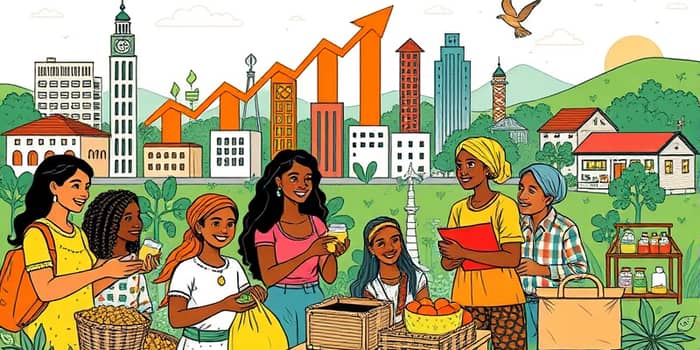
Microfinance has evolved into a transformative force, supporting millions of small businesses and laying the groundwork for inclusive economic growth.
The global microfinance market reached a value of $195.3 billion in 2023, serving around 142 million borrowers with a remarkable 10.1% median growth. Other estimates place the market at $209.08 billion in 2024, with projections soaring to $331 billion by 2029 and even $536.46 billion by 2032 at a 12.5% CAGR.
Amid these gains, approximately 1.4 billion unbanked adults worldwide highlight the immense potential for financial inclusion. Asia—especially South and Southeast Asia—dominates this landscape, accounting for 71.8% of global microfinance borrowers.
Microfinance institutions (MFIs) focus on micro, small, and medium enterprises—often informal—and the low-income households, rural communities, and women excluded from traditional banking.
The funding gap for MSMEs in developing economies stands at about $5.2 trillion, swelling to $8–9 trillion when informal enterprises are included. These small businesses already generate over 60% of global employment, underscoring the sector’s critical role.
In 2023, data from 21 lenders across 13 countries show that microfinance supported the creation of over 1.4 million jobs, as entrepreneurs expanded or launched new ventures.
The 2025 Microfinance Index surveyed more than 24,450 clients in 39 countries, representing 25 million people. It employs a multi-dimensional impact measurement framework that examines six key dimensions:
Microfinance has a longstanding reputation for driving women’s economic empowerment and agency. The 2025 Index highlights shifts in women’s participation, control over loan use, and contributions to household income.
Yet, the World Bank’s Global Findex reports persistent gender gaps in account ownership and digital financial services, particularly in low-income countries. With 1.4 billion adults still unbanked, MFIs play a pivotal role in bridging these divides.
Governments and development partners bolster inclusion through credit bureaus, public funding, guarantees, and supportive regulations tailored to underserved populations.
South & Southeast Asia remain the epicenter of microfinance, home to nearly 72% of borrowers. In India, projected to become the world’s third-largest economy by 2027, microfinance supports a burgeoning entrepreneurial ecosystem.
Vietnam’s rapid adoption of digital lending platforms and Indonesia’s dynamic fintech sector—expected to generate $8.6 billion in revenue by 2025—illustrate how technology amplifies reach and efficiency.
In Sub-Saharan Africa, a doubling population by 2050 and twelve of the world’s fastest-growing economies underscore the urgent demand for MSME finance. East Africa’s projected 5.7% growth (2025–26) is closely tied to digital financial inclusion efforts.
Latin America and the Caribbean, recovering from recent slowdowns, stand to benefit from nearshoring trends that boost local MSMEs. With private sector credit at just 50–60% of GDP, there is ample room to expand microfinance offerings.
In Europe, Central Asia, and the MENA region, MFIs serve refugees, migrants, and rural entrepreneurs, demonstrating the model’s adaptability across diverse socio-economic contexts.
The microfinance sector is poised for unprecedented global growth opportunities, driven by digital innovation, climate finance, and public–private partnerships.
By building financial resilience at scale, MFIs can help small businesses withstand shocks—from pandemics to natural disasters—while fostering sustainable development.
As stakeholders—governments, investors, NGOs, and entrepreneurs—join forces, microfinance’s transforming millions of lives continues. This is more than a lending model; it is a pathway to dignity, autonomy, and enduring economic empowerment for communities worldwide.
References