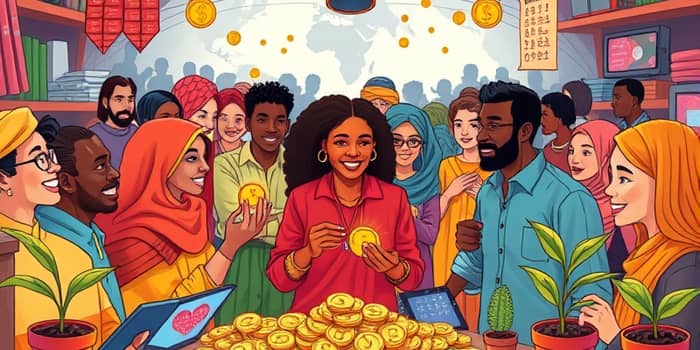
In a world where economic barriers often stifle dreams, microfinance emerges as a powerful catalyst for change.
It provides small loans and financial services to those excluded from traditional banking, sparking entrepreneurial spirit across the globe.
With the global microfinance market projected to soar past $310 billion by 2025, its transformative impact is undeniable.
This growth reflects a deepening commitment to financial inclusion and poverty alleviation.
Every statistic tells a story of resilience, innovation, and hope.
Microfinance is more than just lending; it's about building sustainable futures.
The market's expansion is driven by digital innovations and supportive policies that reach the underserved.
Various sources provide insights into this vibrant growth, highlighting both current valuations and future projections.
Below is a table summarizing key data points from recent studies.
These figures, though varied, consistently point to robust and sustained growth in the coming years.
Factors fueling this trajectory include several key elements.
This combination of forces ensures microfinance remains a vital tool for development.
Microfinance touches the lives of 142 million borrowers worldwide as of 2023, with an annual growth of 8.4%.
This reach is profoundly human, focusing on empowering vulnerable populations.
Key borrower segments highlight its targeted impact.
Regional concentration reveals significant patterns in global distribution.
South and Southeast Asia hold 71.8% of global borrowers, indicating a strong foothold.
Asia overall accounts for over 60% of assets, with India and Bangladesh leading the charge.
Other regions, like Latin America and the Caribbean, hold 16% market share, contributing to diverse success stories.
This geographical spread ensures microfinance adapts to local needs and cultures.
Microfinance's impact extends far beyond individual loans into broader societal benefits.
It has the potential to create 20 million jobs, especially in the poorest and rural areas.
Micro, small, and medium enterprises (MSMEs) are crucial, contributing more than 60% of employment globally.
The average repayment rate of 96% worldwide demonstrates high trust and reliability among borrowers.
This success is vital in addressing the MSME financing gap, estimated at $5.2 trillion in developing economies.
Household effects are measured through comprehensive dimensions that ensure holistic progress.
Focus areas include gender impact and climate resilience, promoting sustainable development.
Key impact measurements are outlined in tools like the 2025 Microfinance Index.
These dimensions help tailor microfinance to real-world challenges and opportunities.
Different regions showcase unique successes driven by microfinance.
Asia remains the dominant player, with India and Bangladesh leading in asset concentration.
Fintech innovations in Indonesia account for 20% of ASEAN companies, with revenue projected to reach $8.6 billion by 2025.
Vietnam sees a digital lending surge, enhancing accessibility for entrepreneurs.
In Africa, Sub-Saharan growth is notable, with Kenya and India leading a 30% rise in digital small lending by 2024.
East Africa anticipates 5.7% growth from 2025-26, supported by a doubling population by 2050.
Latin America and the Caribbean focus on MSME recovery, with private credit levels below US and EU but rising.
Europe and Central Asia show 8% annual growth in Eastern Europe, integrating microfinance into broader economic strategies.
These insights highlight how microfinance adapts to local contexts, driving tailored solutions.
The microfinance sector is evolving rapidly with technological and demographic shifts.
Digital transformation is at the forefront, with a 30% global increase in small digital lending by 2024.
Mobile banking and digital wallets revolutionize access in regions like East Africa and Asia.
Demographics play a crucial role, with emerging markets driving population and income growth.
India is poised to become the third-largest economy by 2027, fueling entrepreneurship.
Africa's expanding workforce presents opportunities for microfinance to support new ventures.
The 2025 outlook includes rising demand in rate-reducing countries and policies supporting MSME finance.
Sustainable energy and connectivity opportunities are emerging as key growth areas.
These trends ensure microfinance stays relevant and impactful in a changing world.
While microfinance thrives, it faces obstacles like conflicts and infrastructure gaps in some regions.
Varying market estimates remind us of the need for standardized data and transparency.
However, tools like the 2025 Microfinance Index offer robust frameworks for assessment.
It involves 85+ financial service providers and 21 partners, focusing on critical areas.
Gender impact and climate resilience are prioritized, ensuring inclusive and sustainable outcomes.
The Global Findex 2025 database tracks financial inclusion trends, offering valuable datasets for policymakers.
High performance in repayment supports poverty alleviation and fosters a culture of entrepreneurship.
By bridging financing gaps, microfinance builds resilient and empowered communities worldwide.
Every loan disbursed is a step towards a more equitable and prosperous future.
Looking ahead, microfinance will continue to play a pivotal role in achieving global development goals.
It inspires hope and provides practical tools for entrepreneurs to thrive against all odds.
This journey is just beginning, with endless possibilities for growth and innovation.
References