As the global population approaches 10 billion by 2050, ensuring sufficient food production on limited arable land has become an urgent challenge. Precision agriculture emerges as a compelling solution, harnessing advanced technologies and detailed data to meet this demand while minimizing environmental impact. This article explores the principles, tools, benefits, and future of precision farming.
Demand for food is projected to rise by roughly 50 percent compared to 2010 levels, even as available farmland per person continues to shrink. Conventional farming practices increase yield through blanket application of water, fertilizer, and pesticides, but this approach contributes to resource depletion, greenhouse gas emissions, and ecosystem damage.
In this context, the sustainability imperative is clear: we must produce more on existing land while conserving water, soil health, and energy, achieving higher yields with lower environmental impact.
Precision agriculture, also known as precision farming or site-specific crop management, is a data-driven approach to farming that uses information technology and tools to ensure crops and soil receive exactly what they need to thrive. By addressing spatial and temporal variability, it optimizes inputs and maximizes outputs.
The conceptual pillars of precision agriculture include:
While most examples focus on crop production—such as row crops, orchards, and vineyards—precision methods are also expanding into livestock management, using technology to optimize feeding, monitor health, and improve overall herd efficiency.
The power of precision agriculture lies in its suite of integrated technologies, spanning the entire production cycle from planning to harvest and beyond. Farmers can leverage these innovations to fine-tune every aspect of their operations.
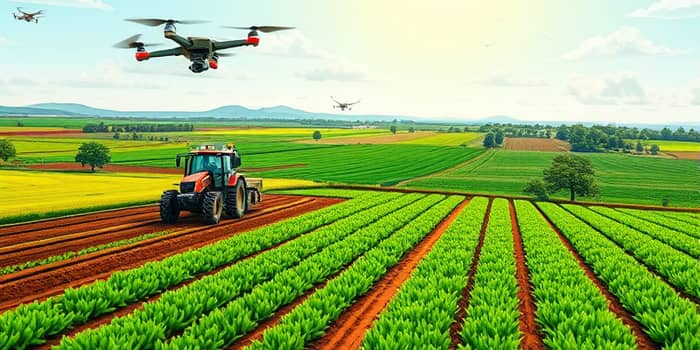
GPS-guided tractors and auto-steer systems ensure that field operations follow the most efficient paths, reducing overlaps and gaps in planting, spraying, and harvesting. These systems can boost operational efficiency by roughly 20 percent, cutting input waste and labor demands.
By combining these technologies, farmers can achieve highly precise water and nutrient delivery throughout the landscape, ensuring that each plant receives optimal care.
Research and industry studies quantify the substantial gains possible with current and full adoption of precision agriculture techniques. In the United States, a landmark 2021 study by AEM, ASA, and CropLife America evaluated the impact of existing practices and projected future gains.
These metrics translate into system-level outcomes such as avoiding conversion of millions of acres of new cropland, saving vast quantities of fuel and water, and cutting chemical usage. Collectively, farmers realize cost savings, stable yields, and stronger resilience against climate variability.
Despite its promise, precision agriculture faces hurdles that slow widespread uptake. High upfront costs for equipment, sensors, and software can deter smaller farms. Technological complexity and the need for reliable connectivity in rural areas pose additional obstacles.
Other challenges include data management complexities, interoperability issues, knowledge gaps among users, and regulatory or privacy concerns around data ownership and sharing.
Emerging trends suggest that precision agriculture will continue to evolve, integrating new advancements in artificial intelligence, machine learning, and robotics. Predictive analytics will enable farmers to anticipate challenges before they arise, adjusting strategies in near real-time for maximum efficiency.
Innovations on the horizon include advanced phenotyping using high-resolution imagery to select more resilient crop varieties; edge computing on equipment, reducing latency in processing sensor data; decentralized data marketplaces, allowing farmers to monetize anonymized field data; and enhanced carbon accounting tools that reward climate-smart practices through ecosystem service payments.
By embracing these innovations and fostering an ecosystem of collaboration, the agricultural sector can realize the vision of sustainable intensification on existing land. Precision agriculture stands as a beacon of hope, promising to deliver the nourishment our growing world needs while protecting the planet for future generations.
With continued research, investment, and education, precision farming can become the global standard, transforming challenges into opportunities and ensuring that feeding the world sustainably is not just an aspiration, but a tangible reality.
References