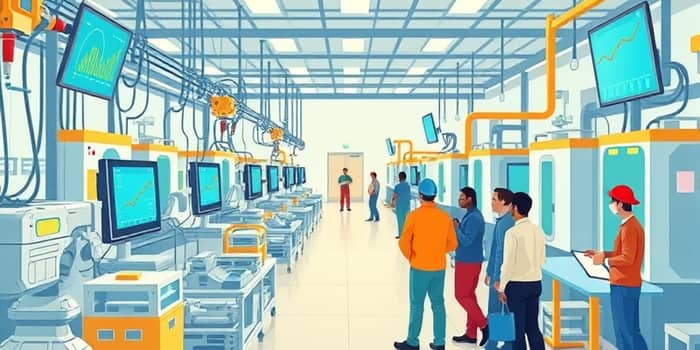
Manufacturing is no longer confined to distant shores; it is coming home with a powerful new rhythm.
This shift is reshaping industries, driven by a quest for stability and growth in an uncertain world.
With 74% of manufacturers reshoring or nearshoring operations, the movement is accelerating at an unprecedented pace.
Companies are realizing that resilience is not just a buzzword but a critical survival strategy.
The stakes are high, and the opportunities are vast for those who adapt.
Re-shoring offers a path to stronger, more reliable supply chains.
However, it comes with significant documentation challenges that can slow progress.
New suppliers often require extensive paperwork, creating bottlenecks.
For instance, onboarding a single supplier can involve 50-100 documents per supplier, leading to delays.
Manual processes take 6-12 months per supplier, which adds up quickly.
A company with 15 new suppliers might face 7-15 years of sequential onboarding.
This highlights the need for smarter, automated solutions.
Key strategies include:
By treating documentation as infrastructure, manufacturers can achieve true agility.
This approach reduces risks and enhances operational efficiency.
Artificial intelligence is no longer a luxury; it is a necessity in modern manufacturing.
In 2026, AI is considered an operational standard, transforming how factories operate.
Investments in AI are soaring, with 95% of firms already committed or planning to invest.
Applications range from predictive maintenance to real-time quality control.
Advanced uses include agentic AI for autonomous decision-making.
This technology helps mitigate sourcing challenges and optimize production.
About 22% of manufacturers plan to use physical AI, like robotic dogs, by 2027.
Foxconn, for example, is reshaping into an AI-powered workforce.
The benefits are clear: improved output and reduced downtime.
To leverage AI effectively, manufacturers should focus on:
Delaying AI adoption can lead to competitive disadvantages.
Embrace it now to stay ahead in the fast-evolving landscape.
The manufacturing workforce is evolving, blending traditional skills with digital expertise.
One major challenge is filling the talent skills gap, which hampers growth.
High-tech, high-wage roles are gaining ground, while low-wage occupations decline.
This shift requires new training initiatives and hybrid roles.
For example, the GE Aerospace Foundation is investing $30 million to train 10,000 skilled workers.
Companies like Flex and Siemens are also funding educational programs.
Key aspects of this transformation include:
By fostering a skilled workforce, manufacturers can drive innovation.
This ensures long-term sustainability and competitiveness.
Global trade tensions are pushing companies to rethink their strategies.
Many are doubling down on U.S.-based production to protect supply chains.
This has led to over $500 billion in private investments in sectors like chipmaking.
Such investments support more than 500,000 jobs and triple domestic capacity.
Reshoring will continue to drive facility expansions, especially in the Midwest.
Early adopters gain control over supply chains and cost stability.
To capitalize on this, manufacturers should:
This strategic shift offers resilience against global uncertainties.
Digital transformation is key to modern manufacturing, but it comes with risks.
Smart manufacturing is viewed as the primary driver of competitiveness in coming years.
Tools like automation hardware and data analytics are foundational.
However, cybersecurity challenges are causing a slowdown in cloud-based software adoption.
Manufacturing Operations Management solutions are vulnerable to breaches.
Software-defined automation offers a solution by decoupling hardware and software.
It encourages open ecosystems and streamlines system rollouts.
Benefits include removing IT/OT silos and scalable automation.
To navigate this, focus on:
This balance ensures innovation without compromising security.
Sustainability has moved from aspiration to action in manufacturing.
Re-shoring aligns with environmental goals by reducing long-distance logistics.
About 20% of imports can be sourced domestically with no cost penalty and environmental benefit.
Circular economy practices, like remanufacturing, require component-level traceability.
This involves tracking material composition and repair history.
Many manufacturers struggle with documentation for products returning after years.
As one expert notes, you can't aggregate what you can't verify.
Key actions include:
This not only helps the planet but also enhances brand reputation.
Re-shoring is more than a trend; it is a strategic imperative for the future.
By embracing these rhythms, manufacturers can build resilient, innovative, and sustainable operations.
The new beat of global manufacturing is here, and it is time to dance to its tune.
Take action now to leverage technology, train your workforce, and invest domestically.
This will ensure long-term success in an ever-changing world.
References