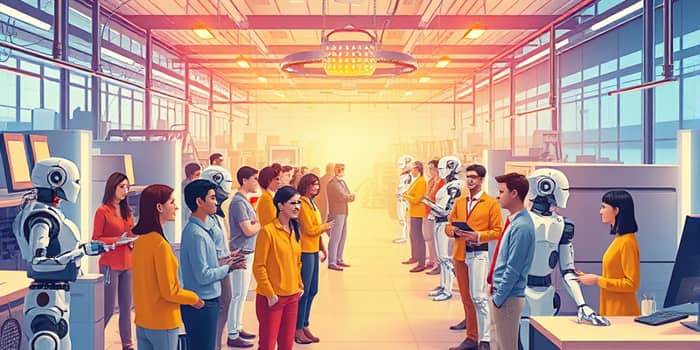
The rapid evolution of robotics and automation is not about erasing jobs; it’s about transforming what people do and how. From factory floors to white-collar offices, this revolution is reshaping the size, skills, structure, and geography of work.
The industrial automation and control systems market is on a remarkable trajectory. Projections estimate it will reach $226.8 billion in 2025, up from $206.3 billion in 2024, driven by Industry 4.0, AI integration, and rising labor costs and competitive pressure. A robust 10.8% CAGR is expected from 2025–2030, with Asia-Pacific accounting for nearly 39% of 2024 revenue through heavy investments in China and South Korea.
Globally, the scale of robotics is staggering: by the end of 2023, 4.28 million industrial robots were in operation, with 541,302 new installations that year. Forecasts predict 555,000 new robots in 2025 and higher thereafter, raising the value of installations to US$16.5 billion. Robot density more than doubled from 74 to 162 robots per 10,000 manufacturing workers between 2016 and 2023, led by South Korea (1,012 robots) and Singapore (730 robots) per 10,000 employees.
Automation is no longer confined to manufacturing. By 2025, 78% of companies will deploy AI in at least one business function, and 51.3% plan to adopt robots or non-humanoid technologies before 2027. Across sectors:
Industrial robots dominate assembly, warehousing, and logistics, while Robotic Process Automation (RPA) is streamlining finance, HR, IT, and customer service. The shift from task-level automation to hyperautomation combining AI, RPA, and orchestration tools is accelerating workflow efficiency. In fact, generative AI tools boost business user task throughput by 66% on average.
The ROI on automation can be transformative. RPA projects frequently deliver 30%–200% ROI in the first year, translating into double-digit cost savings and productivity gains. Software teams using AI-assisted development report completing 126% more projects, and industries most exposed to AI achieve roughly three times higher growth in revenue per employee, with wages rising twice as fast.
Nonetheless, about 70% of digital transformation and automation initiatives fall short of expectations, often due to poor change management or strategy misalignment. To succeed, businesses are advised to target repetitive, high-impact tasks, leverage flexible Robotics-as-a-Service models for agile deployment, and redesign processes to foster human-robot collaboration.
Contrary to doomsday scenarios, automation is poised to yield a net increase in jobs. By 2025, AI is projected to create 97 million new roles while eliminating 85 million, for a net gain of 12 million jobs. By 2030, displacement of 92 million positions may coincide with the creation of 170 million new ones, culminating in a net gain of 78 million jobs worldwide.
That said, 44% of workers will need reskilling or upskilling within five years. Task-level shifts will redefine roles rather than fully automate them: roughly 60% of jobs will undergo significant changes by 2030, and 30% of U.S. jobs could be fully automated. Advanced economies face higher exposure (60% of jobs) compared to lower-income countries (26%).
Regional insights reveal stark contrasts. In the U.S., automation has contributed to 1.7 million manufacturing job losses since 2000, yet about 23.5% of companies now replace tasks with AI tools like ChatGPT. In China and ASEAN, robots created more skilled jobs than they displaced low-skilled roles. Europe sees slower adoption, with each additional robot per 1,000 workers reducing employment by 0.2 percentage points.
We stand at a crossroads between opportunity and disruption. To harness the promise of robotics and automation:
Policymakers, educators, and industry must unite to ensure equitable access to training, support transitions, and guide ethical deployment. By combining human creativity with robotic precision, we can build a workforce that is more productive, adaptable, and fulfilled.
As automation reshapes the world of work, those who adapt, learn, and collaborate will not just survive—they will thrive in the next era of human achievement. The future workforce is not a distant vision; it is ours to design today.
References