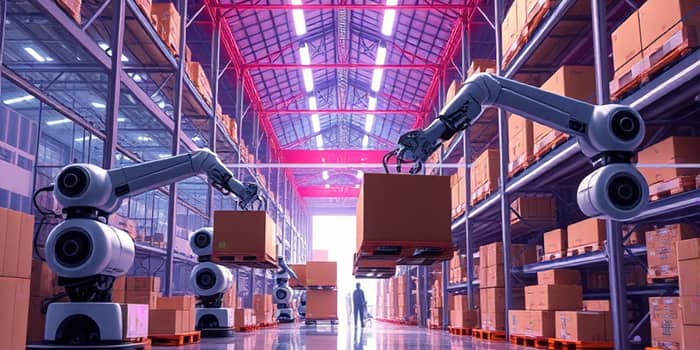
From humming factory floors to sprawling fulfillment centers, robotics and automation are rewriting the playbook for global industries. Advances in artificial intelligence, edge computing, and sensor technology are fueling a revolution that promises to boost productivity, reduce costs, and unlock new opportunities.
As these smart machines evolve, companies face both an inspiring vision of the future and practical decisions about implementation. This article explores the current landscape, key drivers, concrete benefits, and steps to embrace automation successfully.
Market research forecasts a transformation on an unprecedented scale. The overall robotics market is projected to reach USD 70–80 billion by 2026, with industrial and logistics segments accounting for roughly 60–65% of that growth. Alternative estimates suggest a climb from USD 75.43 billion in 2025 to USD 245.59 billion by 2030, driven by warehouse automation and AI-powered systems.
Warehouse automation alone stood at USD 29.98 billion in 2026, set to double to USD 59.52 billion by 2030 at a CAGR of 18.7%. Meanwhile, AI-based industrial robots will grow from USD 16.8 billion in 2025 to USD 33.3 billion by 2035 at a steady 7.1% CAGR.
This regional breakdown highlights Asia-Pacific’s dominance, led by China, South Korea, and Japan, while North America excels in white-collar automation and Europe accelerates factory modernization.
Several converging factors are propelling robotics adoption at record pace. Leaders in automation are tapping into these trends to stay ahead:
With these drivers in place, companies are realizing unprecedented efficiency gains that translate directly to the bottom line.
Embracing robotics can appear daunting, but a structured approach makes transformation attainable. Below are key benefits and an actionable roadmap to guide executives and managers.
To convert potential into performance, consider a step-by-step implementation framework:
Despite compelling benefits, hurdles remain. Upfront investment, integration complexity, and change management can slow progress. Organizations can mitigate these risks by:
• Selecting modular, scalable systems that align with existing infrastructure.
• Engaging stakeholders early to build trust and clarify roles in a human-robot collaborative environment.
• Leveraging government incentives and industry partnerships to offset capital expenditure.
Looking beyond 2026, the landscape becomes even more exciting. Experts predict the rise of fully autonomous factories by 2030, where minimal human intervention is needed for routine tasks. Workforce transformation will create new roles in robot maintenance, AI oversight, and data analytics.
Key trends to watch include:
As robotics reshape industries, companies that embrace innovation today will define tomorrow’s competitive landscape. By blending human creativity with machine precision, organizations can unlock remarkable productivity, sustainability, and growth.
The path forward is clear: adopt a strategic, stepwise approach, invest in both technology and people, and maintain agility to evolve with emerging breakthroughs. In doing so, businesses won’t just survive the robotic revolution—they will thrive at its forefront.
References