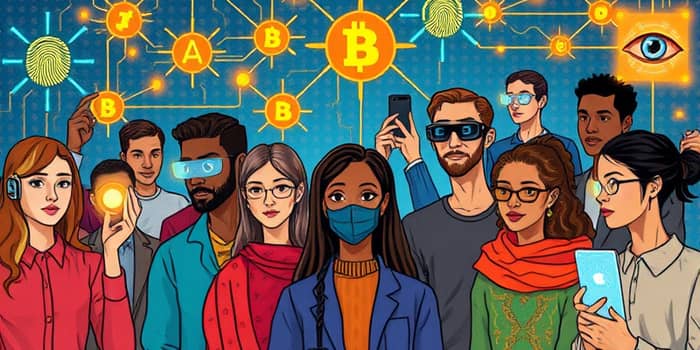
In today’s banking landscape, identity thefts and cyber intrusions cast long shadows over trust. Account takeovers and fraudulent transactions ripple through economies, leaving individuals vulnerable and institutions exposed. As fraudsters become more sophisticated, they weaponize social engineering, deepfake technology, and phishing campaigns to breach traditional password-based defences.
Against this backdrop, biometric solutions promise an era of unparalleled security and seamless convenience. They offer authentication based on innate human characteristics—fingerprints, facial patterns, voiceprints, and more—ushering in a transformative wave that safeguards assets and empowers customers.
Beyond mere technology, biometrics can galvanize financial inclusion, bridging gaps for underbanked communities and reshaping how society views identity, trust, and accessibility in the digital age.
The biometrics for banking and financial services market is experiencing a monumental surge. Valued at USD 9.15 billion in 2025, analysts forecast it will soar to over USD 22 billion by 2032 at a robust 13.52% compound annual growth rate. An alternative projection paints an even more ambitious picture—achieving USD 42 billion by 2035 at a 15.6% CAGR.
Underlying these colossal figures is the ceaseless battle against cyber fraud. The FBI’s 2023 report highlights more than USD 12.5 billion in losses due to online financial crimes, a 10% uptick in complaints, and a 22% spike in total financial damage. In response, banks are abandoning static passwords in favor of dynamic, continuous authentication mechanisms powered by biometrics and AI.
From New York to Nairobi, financial institutions are racing to integrate biometric solutions into mobile apps, ATMs, and branch networks. This momentum reflects a universal demand for secure, frictionless customer experiences—where logging into an account or approving a payment can be as simple as a glance or a touch.
At the heart of this seismic shift lie core biometric modalities that merge hardware, software, and intelligence into resilient security ecosystems. Each technology brings unique strengths and faces distinct challenges:
Innovations from industry leaders redefine what’s possible. NEC’s privacy-preserving facial matching platform encrypts biometric data at every stage, eliminating raw data storage. IDEMIA’s TrustedBio sensor embeds fingerprint recognition directly into payment cards, enabling tap-to-pay transactions with biometric validation. These solutions deploy seamlessly across cloud-native, on-premises, and edge environments—meeting varied regulatory and infrastructural needs.
Biometric authentication generates tangible results in fraud reduction and user satisfaction. Institutions report:
Customers also reap the rewards of instant, password-free customer interactions. Over 280 million online and mobile bank accounts were opened in 2022, many leveraging face verification and fingerprint login features. Biometric payments are slated to reach USD 5.765 trillion in annual transaction value by 2026, with more than 3 billion users tapping, scanning, or speaking to authenticate.
Moreover, these systems foster financial inclusion. In regions where literacy rates vary, biometric onboarding bridges the gap, enabling remote Know Your Customer processes that comply with global regulatory frameworks and local identity schemes.
While biometric technology fortifies defences, it also faces evolving threats. AI-driven deepfakes can mimic voices or forge facial data, challenging legacy systems that lack advanced liveness detection. Fraudsters continuously probe for vulnerabilities, creating synthetic identities that blur the line between legitimate and fraudulent users.
Data privacy and sovereignty remain paramount concerns. Storing sensitive biometric templates in shared cloud environments raises questions about jurisdiction, consent, and potential misuse. Financial institutions must balance innovation with rigorous governance, deploying privacy-by-design governance frameworks that encrypt, tokenize, and decentralize biometric information.
Additionally, single-modality approaches can be insufficient. As challenges grow, banks must adopt multi-modal and continuous authentication frameworks that monitor behaviour patterns, device signatures, and environmental signals to maintain rigorous security postures.
Regional adoption patterns illuminate varying drivers and success stories:
North America’s projected CAGR of 7.8% from 2026 to 2035 underscores explosive growth in contactless, on-device biometrics. Meanwhile, Africa leverages fingerprint scanning to extend banking services to remote and rural populations, driving social and economic development.
To harness the full potential of biometric frontiers, banks and financial players should consider the following strategic imperatives:
By aligning technology roadmaps with customer-centric goals, institutions can craft cost-effective, future-ready security architectures. Transparent governance frameworks, continuous performance monitoring, and user education further strengthen uptake and trust.
As we stand at the brink of a new biometric era, the imperative is clear: banks that embrace these advances will not only outpace competitors but also fortify the very essence of financial trust.
Secure identity is no longer a distant vision—it is the frontier of financial access. By merging innovation with empathy, institutions can unlock a world where every individual engages with banking services confidently, safely, and without barriers.
References