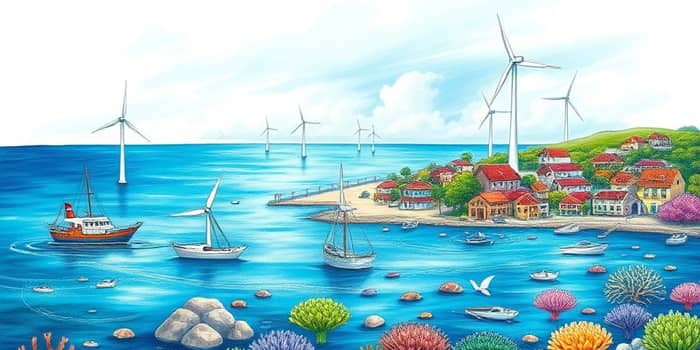
Picture a future where oceans are not just vast waters but engines of prosperity and healing. The sustainable use of ocean resources can make this vision a reality.
This concept, known as the Blue Economy, is about more than economics. It integrates growth with ecological balance.
By embracing this approach, we tap into trillions of dollars in opportunities that can transform communities worldwide. Every investment here is a step toward resilience.
At its heart, the Blue Economy aims for economic growth, improved livelihoods, and jobs while protecting marine health. It merges human needs with nature's gifts.
Definitions vary, but the core idea remains constant. The European Commission sees it as all ocean-related activities.
The Commonwealth focuses on better stewardship of blue resources. Conservation International adds non-market benefits like carbon storage.
Ultimately, it is a framework for sustainable development. It ensures that our oceans thrive for generations.
These elements work together to create a holistic system. Innovation drives progress in this space.
Ocean-based industries currently contribute $1.5 trillion annually to the global economy. This figure is just the beginning.
With sustainable practices, it could double to $3 trillion by 2030. This potential highlights a massive opportunity.
In the United States, the marine and coastal economy adds $432 billion to GDP. It supports millions of jobs across various fields.
Coastal and marine tourism requires $65 billion yearly for climate resilience. Investing here can reduce global greenhouse gas emissions by 35%.
Initiatives like CAF commit $2.5 billion through 2030 for Latin America and the Caribbean. This funding covers oceans preservation and clean tech.
The Blue Economy spans diverse areas, each with unique potential. Let's explore the main sectors.
Here is a table summarizing these opportunities:
These sectors are interconnected. Success in one can boost others, creating a ripple effect.
A major challenge is avoiding profit-over-sustainability models. Growth must not harm communities or ecosystems.
Threats include pollution, seabed mining, and habitat destruction. These erode biodiversity and essential services like coastal protection.
Coastal nations control resources in Territorial Seas and Exclusive Economic Zones (EEZs). Proper management is crucial for long-term health.
Balancing economic activities with conservation is key. It ensures that the Blue Economy remains a force for good.
Investment trends show growing interest in climate and biodiversity impact investing. Private capital is flowing into this space.
Strategies include grant funding and engaging buyers from fishers to corporations. Nature-positive infrastructure is essential for scalability.
NOAA supports planning with data, while global collaborations like the Ocean Breakthroughs aim for net-zero by 2050. These efforts align incentives and increase funding.
The Blue Economy is a global movement with local impacts. Different regions are taking action.
The Ocean Breakthroughs initiative targets key areas like marine conservation and shipping decarbonization. It sets a path for a sustainable future.
Investing in the Blue Economy is a commitment to preserving our planet for future generations. It offers a path to resilience and shared prosperity.
By adopting sustainable practices, we can harness the ocean's vast potential. This journey requires collaboration and vision.
Every individual, investor, and community has a role to play. Let's build a thriving blue future together.
References