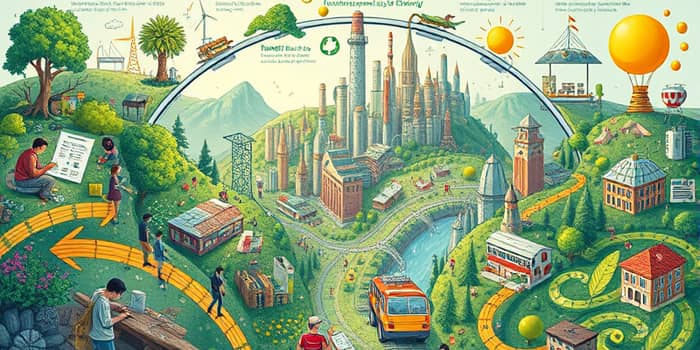
As the world confronts mounting resource constraints and environmental crises, the circular economy emerges as an inspiring blueprint for sustainable growth. By transforming waste into opportunity and aligning industry with nature’s rhythms, this model promises a resilient, low-carbon future.
The circular economy is more than a buzzword—it is a transformative system designed to keep products, materials, and energy in use for as long as possible. It overturns the outdated linear approach of “take-make-use-dispose” by embedding three foundational principles into design and operation:
First, eliminate waste and pollution from design onward, ensuring that every product is conceived with its end-of-life in mind. Second, circulate products and materials through repair, reuse, and recycling, closing loops to minimize reliance on virgin resources. Third, regenerate nature by restoring ecosystems, embedding biodiversity and soil health into supply chains.
At the heart of these principles lie the nine Rs—refuse, rethink, reduce, reuse, repair, refurbish, remanufacture, repurpose, recycle—and the recovery of residual value. Together, they form the most comprehensive roadmap toward a truly circular model:
Transitioning from a linear to a circular model can reshape industries, bolster economies, and heal the planet. The following table highlights core distinctions:
Embracing a circular model generates profound advantages for economies, businesses, communities, and individuals:
Viewing waste as opportunity, investors can channel capital into infrastructure that optimizes recovery of valuable materials. Recycling end-of-life solar panels and lithium-ion batteries, for instance, yields critical minerals like nickel, cobalt, and lithium with 80% lower greenhouse gas emissions than mining.
Strategic investments in collection networks, domestic refining capacity, and advanced sorting technologies build stable, low-risk supply chains. Extended Producer Responsibility (EPR) schemes and deposit-return systems further drive circularity in sectors such as packaging, textiles, and electronics.
Governments worldwide are aligning policies to accelerate circular transitions. The European Union’s 2020 AGEC Law mandates sorting and recovery targets, eco-design requirements, and recyclable packaging standards. France’s 2015 Energy Transition Act emphasizes eco-design and waste reduction at a national level.
In the United States, 2026 priorities include worker protections, incentives for domestic feedstock production, and EPR frameworks for batteries and textiles. Globally, bodies like the UNDP and World Economic Forum underscore the need for cross-sector collaboration to scale best practices.
Companies and communities can adopt practical measures to kickstart circular initiatives:
Industries from clean energy to textiles are experimenting with take-back programs, modular product designs, and energy-efficient manufacturing technologies. While challenges remain—such as building robust collection systems and scaling refining capacity—the momentum is undeniable.
Transitioning to a circular economy is not merely a technical challenge—it is a collective vision for a world where prosperity and nature flourish side by side. By treating waste as valuable resources and embedding circular principles into every stage of production and consumption, we can achieve climate neutrality, bolster economic resilience, and regenerate natural systems.
This journey demands bold leadership, cross-sector collaboration, and a willingness to innovate. Every stakeholder—governments, businesses, investors, and consumers—has a role in this transformation. Together, we can turn the promise of a waste-free future into a reality that benefits all life on our planet.
References