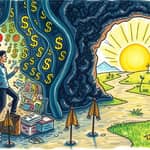
In today's complex financial world, many feel lost in a fog of financial uncertainties and overwhelming data.
Financial cartography offers a beacon of hope, transforming confusion into clear visual understanding of your monetary path.
This innovative approach is the art of mapping assets and liabilities to navigate from current status to long-term goals like generational wealth.
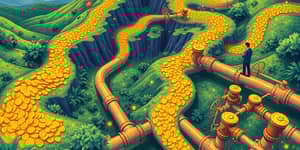
Imagine having a GPS for your finances, one that updates in real-time and guides every decision.
Financial cartography does just that, providing a dynamic map of your financial landscape.
It replaces spreadsheets with interactive views, making complex structures simple and actionable.
The concept of mapping finance isn't new; it has historical ties to banknotes and trade maps.
From maritime charts used in colonization to modern financial visualization, or FinVis, the journey has evolved.
Financial genograms, for instance, offer a multi-generational visual of money behaviors, helping to heal relationships with wealth.
This evolution shows that finance, often seen as arcane, is being brought back to Earth through geography.
Today, it's an ongoing process, not a one-time task, adapting as life changes.
This continuity ensures that your map grows with you, reflecting new phases and goals.
At its core, financial cartography involves several key components that work together to create a comprehensive map.
These components help visualize connections, assess risks, and plan for the future effectively.
Below is a table outlining the main components of a financial map.
Creating such a map starts with gathering data from banks, brokerages, and family records.
Then, using tools, you can plot this information to see the big picture.
This process demystifies complex structures and reveals hidden opportunities for optimization.
To begin your own map, follow these initial steps:
These steps ensure that your financial journey is always clear and directed.
Embracing financial cartography brings numerous advantages that can transform your financial health.
Here are some key benefits:
For example, the Bardfour family office restructured their ownership visually, leading to better management.
This shows how practical applications yield tangible results in real-world settings.
By leveraging these benefits, you can move from uncertainty to empowered action.
Modern financial cartography relies on advanced tools that make mapping accessible and powerful.
Key interactive features include:
Technologies auto-pull data from financial institutions, saving time and reducing errors.
Platforms like Asora are designed for family offices, while others cater to individuals.
Financial genogram tools help identify patterns sabotaging future wealth and integrate with wellness strategies.
FinVis projects even visualize global finance networks, making abstract concepts tangible.
These tools transform raw data into actionable insights for daily use.
Despite its benefits, financial cartography faces challenges that need addressing.
Common issues include:
Solutions involve education, using non-technical language, and focusing on emotional aspects.
By tackling these, financial cartography becomes a tool for empowerment and financial wellness.
It turns obstacles into opportunities for growth and understanding.
Financial cartography has diverse applications across personal, family, and global scales.
Here are some use cases:
These applications show that whether for individual growth or societal good, mapping is key.
From small budgets to large estates, everyone can benefit from this approach.
Financial cartography is more than a tool; it's a mindset shift towards proactive wealth management.
By mapping your monetary journey, you gain control over your financial destiny and inspire others to do the same.
Start today by sketching your first map, using available tools or simple drawings.
Remember, as one source puts it, "Instead of drowning in data, you get clarity. Instead of confusion, you get understanding."
Embrace the role of the financial cartographer and chart a course to a secure and prosperous future.
Your journey begins with a single map, leading to endless possibilities.
References