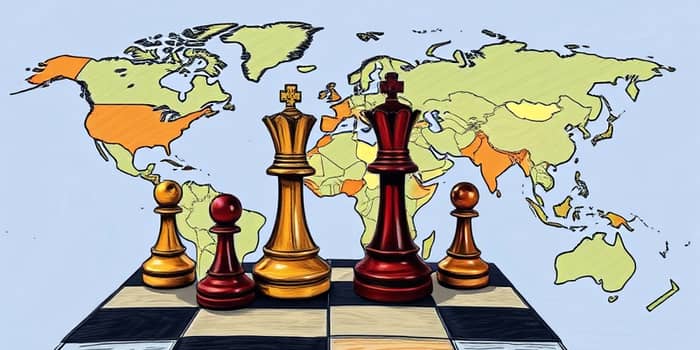
The world in 2026 is a complex arena where geopolitical risks reshape every facet of global affairs.
Investors face a daunting yet transformative environment, marked by intense rivalries and shifting alliances.
This article provides a detailed roadmap to navigate these challenges, offering practical strategies for turning uncertainty into opportunity.
Core Geopolitical Themes Shaping 2026
At the heart of this era is the US-China great power competition, which extends beyond trade into technology and ideology.
This rivalry drives a fragmented global order, where traditional alliances weaken and new power centers emerge.
Structural changes like multipolarity are evident, with actors such as the EU and Global South actively reshaping trade patterns.
Europe, for instance, is pursuing deals with regions like Mercosur to access 2 billion customers, showcasing adaptability.
National security is now a top priority, influencing economic policies and investment flows worldwide.
Major Hotspots and Escalating Risks
Several regions pose critical threats that could disrupt global stability.
- Russia and Ukraine: The ongoing war forces Europe to increase defense spending amid weakening US security guarantees.
- East Asia and China-Taiwan: Steady US-China ties mask Beijing's grey-zone coercion in maritime areas, risking regional tensions.
- Middle East: Tentative de-escalation offers hope, but underlying conflicts persist, demanding vigilance.
- South Asia: India-Pakistan tensions flare post-terrorist attacks, with Pakistan's military emboldened by constitutional changes.
- Venezuela and the US: American actions add volatility, highlighting broader instability in the Americas.
- Other risks include unprecedented global conflicts, climate change impacts, and AI cyber vulnerabilities targeting critical infrastructure.
Top Geopolitical Risks to Monitor
Key dangers could redefine the investment landscape in 2026.
- US Political Revolution: Potential transformative policies under a Trump administration, such as Supreme Court rulings and tariff hikes, erode institutional confidence.
- Fragmented Global Order: The decline of US leadership sees the Global South seeking larger roles, while EU populism and immigration strains cause fragmentation.
- Elections Worldwide: Critical votes in the US, Russia, Israel, Brazil, and Hungary amplify foreign policy uncertainty and market volatility.
Economic and Market Impacts
Investors must prepare for structurally higher inflation and lower growth compared to globalization's peak.
Trade realignment is accelerating, with US tariff hikes and bilateral deals replacing WTO norms, affecting foreign direct investment.
These factors create a macro differentiation environment, where regions experience varied economic outcomes.
Investment Opportunities and Strategic Approaches
Despite challenges, compelling regions offer growth potential for savvy investors.
- Europe: Benefits from fiscal expansion, increased defense spending, and monetary support, narrowing the gap with the US.
- India: Leverages demographics, digital transformation, and supply chain integration for robust growth.
- China: Taps into market depth, innovation, and policy-driven initiatives, despite geopolitical headwinds.
Focus on national security themes such as defense, AI, and critical minerals for long-term gains.
- Defense and aerospace sectors are poised for growth with global spending increases.
- AI and emerging technologies offer spillover effects from US-China competition, creating investment niches.
- Critical minerals, biotech, and semiconductors are essential for strategic autonomy and resilience.
Active management is crucial to differentiate across regions, industries, and assets, leveraging geopolitical cycles of 80-100 years.
Key Events to Watch in 2026
Specific milestones will shape the geopolitical and investment landscape.
- January: US Supreme Court decisions on Trump-era policies and potential tariff implementations, setting the tone for the year.
- November: US midterm elections that could shift political dynamics and influence global policies.
- Ongoing: Elections in Russia, Israel, Brazil, and Hungary, along with conflicts in Ukraine and the Middle East, requiring constant monitoring.
Expert Insights and Analytical Frameworks
Leading analysts provide valuable perspectives to guide investment decisions.
- AllianzGI: Markets adapt to a balance of confrontation and compromise, with China prepared for tensions, ensuring balanced power dynamics.
- Wellington Management: Describes the environment as far from "Goldilocks," emphasizing exposure to security themes and the "US vs them" order.
- Eurasia Group: Flags the US Political Revolution as the top risk, with panel discussions highlighting global instability and leadership weaknesses.
- EY: Highlights how the US reshapes the global environment, forcing adaptation by China and the EU in trade and policy.
- Stimson Center: Points to a shaky Asia-Pacific and Europe's realpolitik-driven arming, underscoring regional vulnerabilities.
- Boston Consulting Group: Discusses multipolarity and Europe's trade deals amid new domain conflicts, offering strategic insights.
Conclusion: Navigating with Confidence
In this era of uncertainty, embracing flexibility and scenario planning is essential for investors.
Understanding long-term geopolitical cycles can help identify disruptive winners and losers across markets.
By focusing on resilient regions and security-driven sectors, one can transform risks into profitable opportunities.
The chessboard is set with complex moves; with strategic insight and emotional resilience, you can make informed decisions to secure your future.
Stay vigilant, adapt quickly, and leverage the insights shared here to thrive in 2026 and beyond.