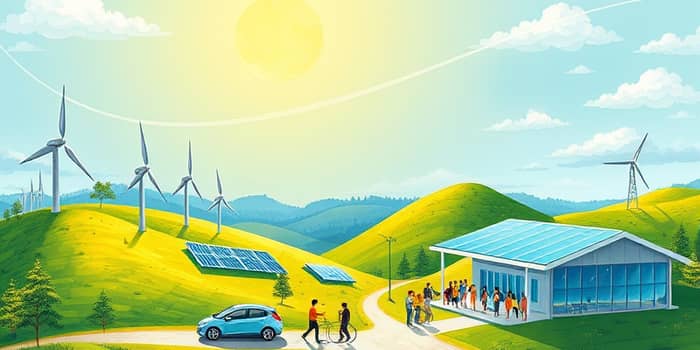
As the world navigates a critical crossroads between economic growth and environmental stewardship, the year 2025 delivered a record-breaking $2.3 trillion investment in clean energy. This milestone is more than a statistic: it reflects unprecedented ambition and technological ingenuity driving a sustainable tomorrow.
At the forefront of capital deployment, electrified transport emerging as a powerhouse has captured the largest share, totaling $893 billion in 2025. From electric vehicles to charging networks, this sector exemplifies a profound shift in mobility paradigms.
Meanwhile, renewable energy installations accounted for $690 billion, reflecting both maturity and volatility. Grid investments reached $483 billion, reinforcing infrastructure resilience. The clean supply chain attracted $127 billion, highlighting the strategic importance of battery manufacturing and critical materials. Climate-tech equity soared 53%, reaching $77.3 billion, while energy transition debt climbed to $1.2 trillion, demonstrating investor appetite for scalable, low-carbon solutions.
These figures underscore global clean energy momentum accelerating despite macroeconomic headwinds and regional policy fluctuations.
Investment distribution reveals concentrated growth in the Asia Pacific, where nearly half of all energy transition capital now resides. China alone funneled $800 billion into the sector, while India's spend rose 15% to $68 billion. The European Union saw robust expansion, with an 18% increase to $455 billion. The United States, navigating policy uncertainties, still managed a 3.5% uptick to $378 billion, underscoring the importance of stable regulatory environments.
These regional insights reinforce the need for diversified regional approaches deliver resilience in policy, finance, and technology collaboration.
As investment surges, legacy fossil assets face growing obsolescence. Stranded assets—facilities or reserves that lose value prematurely—pose systemic financial risks. Drivers include stringent carbon policies, rapid technology cost declines, and evolving consumer preferences.
Unmanaged, these assets can create a carbon bubble, imposing losses on investors and communities reliant on fossil-driven revenues.
To navigate uncertainties and capture upside, stakeholders must adopt holistic sustainability risk assessments. For investors, this means integrating climate scenarios into portfolio analysis, conducting stress tests on high-carbon exposures, and reallocating capital toward resilient, low-carbon enterprises.
Policymakers can accelerate transitions by designing balanced regulatory frameworks and incentives that reward innovation and penalize carbon-intensive activities. Examples include tax credits for renewable deployments, mandates for grid upgrades, and clear timelines for phasing out coal and gas capacity.
Collaboration across public and private sectors will bolster supply chain security, foster job creation in emerging industries, and ensure equity for communities facing workforce disruptions.
Looking ahead, the landscape brims with both promise and complexity. Innovative financing and green bonds will unlock trillions in climate-aligned funding. The rise of data centers, projected at $500 billion of new builds, underscores the intersection of digital transformation and decarbonization.
Grid modernization, through smart networks and storage integration, will enhance reliability and unlock demand-side flexibility. Meanwhile, emerging technologies—green hydrogen, advanced nuclear, and next-generation batteries—offer pathways to decarbonize hard-to-abate sectors. As supply chains evolve, stakeholders must monitor potential oversupply of battery metals and invest in circular economy solutions.
The global energy transition stands at a seminal juncture. Record clean investments are outpacing fossil funding by over $100 billion annually, signaling a lasting structural shift. Yet progress is uneven, and stranded assets loom as cautionary reminders of past misallocations.
By fostering proactive asset retirement planning and leveraging interdisciplinary collaboration, we can mitigate risks and optimize opportunities. Every stakeholder—governments, corporations, financiers, and civil society—has a role in steering capital toward projects that deliver both economic returns and climate resilience.
Ultimately, the scale and pace of the energy transition will define our collective capacity to safeguard prosperity and planetary health. With informed strategies and unwavering commitment, we can write a new chapter—one in which innovation, equity, and environmental stewardship converge to power a thriving, sustainable future.
References