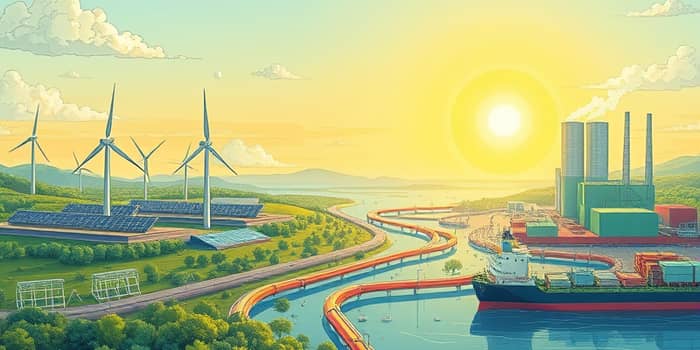
The global energy system stands at a crossroads. As emissions skyrocket and climate goals grow more urgent, a promising solution emerges: green hydrogen. This article explores how hydrogen produced from renewable electricity can reshape industries, transport, power and heating, unlocking a cleaner, resilient future.
By combining cutting-edge technology, bold policy and strategic investment, the green hydrogen economy is set to become a major fuel, feedstock and energy carrier across sectors. Read on to discover the technology basics, market growth, challenges and practical steps forward.
Hydrogen can be produced in multiple ways, distinguished by their carbon footprint. The key categories are:
A true green hydrogen economy envisions large-scale production, trade and use of green hydrogen and its derivatives—e-ammonia, e-methanol, synthetic fuels and green steel—to displace fossil fuels in hard-to-abate sectors with high emissions.
As wind and solar deployments accelerate, intermittent production creates clean power gaps. Hydrogen acts as an energy carrier, balancing supply and demand by storing excess renewable electricity. In transport, hydrogen fuel cells enable heavy-duty trucks, ships and potentially aviation to travel long distances without the weight and range limits of batteries.
Decarbonizing industries such as steelmaking, chemicals and fertilizer production is nearly impossible with electricity alone. IRENA’s 1.5 °C scenario identifies green hydrogen as crucial to meet Paris Agreement targets by 2050, knitting together power, industry and transport systems into a resilient low-carbon network.
Hydrogen demand is forecast to surge. By 2050, scenarios range from 150 to 600 million tonnes per year, with a Paris-aligned path near 350 Mt. Allied Market Research projects the green hydrogen market value to expand by over $140 billion between 2022 and 2032, at a remarkable 50.3% CAGR.
Yet realizing this pipeline demands an unprecedented >90% CAGR from 2024–2030, far outpacing past renewable technology rollouts.
Green hydrogen currently commands a premium, trading at $3.50–$8 per kilogram. However, ongoing cost declines are driven by:
As capacity scales and electrolyser utilization improves, PwC expects green hydrogen to reach parity with other forms from 2030 onward, assuming supportive policy and infrastructure roll-out.
Building a global hydrogen market requires massive investment in pipelines, storage caverns, export terminals for liquid hydrogen or ammonia, and regional import facilities. Large pipelines can take 7–12 years to develop, making immediate planning essential to meet post-2030 demand.
Governments worldwide have mobilized nearly €90 billion for low-emission hydrogen projects. In the EU, new market rules mandate hydrogen certification, permit up to 2% blending in gas networks, and require new gas plants to switch to hydrogen after eight years of operation.
In the U.S., the Inflation Reduction Act introduced a Section 45V tax credit for clean hydrogen, while subsequent legislation shifts incentives toward blue hydrogen with CCS. This could reallocate investment, favoring blue projects in the near term.
Internationally, countries with abundant renewable resources—Australia, Morocco, Chile and parts of the Middle East—are positioning themselves as exporters of green hydrogen and derivatives. Importers such as Japan and Germany have signed letters of intent to secure future supply, knitting together a cross-continental energy ecosystem.
To overcome barriers—high capital costs, infrastructure delays, regulatory uncertainty—stakeholders must collaborate on shared standards, co-investment models and public-private partnerships. Regional clusters that integrate renewables, electrolysers, storage and end-use facilities can accelerate learning and drive down costs.
For businesses and governments, the path forward involves:
By acting decisively today, we can usher in a resilient, low-carbon energy system powered by green hydrogen. This shift promises economic growth, energy security and a sustainable legacy for future generations.
The green hydrogen economy isn’t a distant dream—it’s a tangible vision within our grasp, ready to power the industries, transport and communities of tomorrow.
References