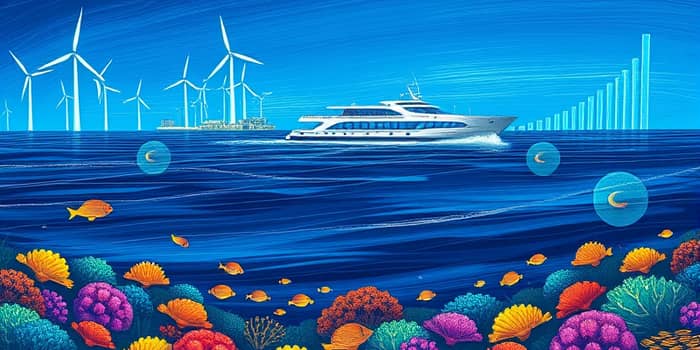
The ocean economy is a dynamic and expanding frontier of global growth, yet it remains undervalued and underfunded. Despite generating trillions of dollars each year and supporting millions of livelihoods, it captures only a fraction of climate and sustainable development finance. This article unveils the vast investment opportunities hidden beneath the waves and shows how closing the funding gap can yield transformative returns.
The term "ocean economy" encompasses all economic activities that use and benefit from ocean resources, including shipping, fisheries, tourism, offshore energy, and technology. The "blue economy" refines this concept by emphasizing sustainability—ensuring that growth also safeguards ocean health and social inclusion.
Together, these sectors employ over 100 million people and generate approximately 3–4% of global GDP. The ocean provides strategic value estimated at USD 24 trillion in goods and services, yet sustainable solutions represent just a fraction of invested capital.
In real terms, the global ocean economy’s gross value added doubled from USD 1.3 trillion in 1995 to USD 2.6 trillion in 2020. If properly managed, OECD and World Economic Forum projections suggest it could quadruple to around USD 10 trillion by 2050.
Global ocean trade reached USD 2.2 trillion in 2023—about 7% of total world trade—and has grown 2.5× since 1995, outpacing the overall economy. Tourism represents roughly one-third of ocean exports, shipping 22%, and high-tech manufacturing 16%, signaling a shift towards innovation-driven growth.
Marine transport underpins global supply chains and accounts for around 22% of ocean-related exports. As the industry faces strict IMO decarbonization targets and rising customer demand for low-carbon logistics, a wave of investment opportunities is emerging.
Early movers in fuel production, battery systems, and smart shipping solutions can capture both environmental impact and robust financial returns as carriers transition fleets worldwide.
Fisheries and aquaculture support the livelihoods of some 600 million people and contribute to food security for billions. Driven by rising global demand for healthy protein, sustainable aquaculture is central to the blue economy’s future.
To meet projected seafood consumption, Morgan Stanley estimates that USD 150–300 billion in capital expenditures will be required over the next decade. Investments in precision feed, recirculating aquaculture systems, and offshore cages can deliver a comparatively low-carbon source of protein while mitigating environmental impacts.
Leading operators are deploying AI-driven monitoring, next-generation feeds, and closed-loop systems that reduce waste and protect wild populations—unlocking both ecological and economic value.
Marine and coastal tourism account for about one-third of ocean exports and rank among the largest employers in small island developing states and coastal regions. As travelers seek eco-friendly experiences, demand for sustainable tourism infrastructure is surging.
Opportunities include green resorts powered by renewable energy, reef-friendly diving and snorkeling operations, and managed marine protected areas funding through visitor fees. Investments in coastal resilience—such as natural barriers, mangrove restoration, and insurance-linked nature solutions—can protect both communities and tourism assets.
Offshore oil and gas have long dominated ocean investments, but the transition to marine renewables is accelerating. Offshore wind capacity is scaling rapidly, and emerging tidal and wave technologies offer exciting frontiers.
With over USD 2.2 trillion directed to clean energy investments in 2025 alone, the ocean economy stands ready to capture substantial capital flows and deliver long-term, stable returns.
Despite its scale—outpacing global GDP growth—and its clear role in climate mitigation, the ocean economy currently receives less than 1% of global climate finance. Bridging this gap requires innovative finance mechanisms and stronger policy support.
Blue bonds, blended finance structures, and performance-based grants can de-risk early-stage projects, while institutional investors increasingly seek assets that combine environmental impact with reliable yields. Public-private partnerships will be crucial in mobilizing the estimated USD 1 trillion annual investment needed to achieve sustainable ocean targets by 2030.
The ocean economy is more than a collection of industries; it is a source of innovation, resilience, and shared prosperity. By directing capital toward sustainable shipping, aquaculture, tourism, and renewables, investors can help secure a net positive economic benefit of over USD 15 trillion and preserve ocean health for future generations.
Seizing this untapped investment potential means generating strong financial returns while safeguarding the planet’s most vital ecosystem. The time to dive in is now—embrace the blue horizon and help chart a path to a thriving, sustainable future.
References