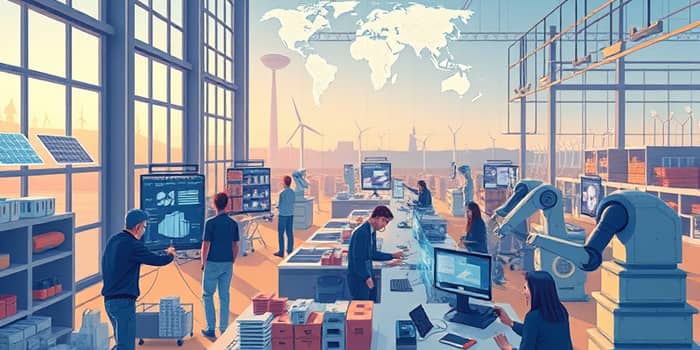
As we move into 2025, the global manufacturing sector is experiencing a remarkable revival. After years of volatility, the industry is rewriting its narrative, driven by regional momentum, technological breakthroughs, and strategic policymaking.
From the bustling factories of India to cutting-edge smart facilities in the United States and the cautious digitization efforts in Europe, this resurgence reflects a world eager to balance growth, resilience, and sustainability.
The rebound in manufacturing is far from uniform. Different regions are charting diverse paths based on demand, investment climate, and workforce dynamics. Understanding these patterns is essential for any stakeholder looking to navigate the evolving industrial landscape.
India stands out with a Manufacturing PMI of 59.2, marking a 17.5-year high and powering the country to become Asia’s leading manufacturing growth story. Fueled by robust global demand and the fastest employment growth on record, investment is surging into infrastructure and capacity expansion.
In the United States, the industry faces a cautious contraction at a PMI of 49.5. Output is up just 0.8% year-to-date, and some sectors align resources through headcount adjustments amid persistent labor shortages of over 400,000 unfilled positions.
Europe and Japan both hover below expansion thresholds, emphasizing selective digitization and efficiency over aggressive output growth. China and other APAC economies exhibit mixed sentiment, balancing strategic patience with targeted tech investment.
Advanced technologies are the engine of this resurgence. Manufacturers are increasingly adopting AI-powered manufacturing solutions and robotics integration, laying the foundation for more resilient, agile operations that can pivot in response to market changes.
The global Industry 4.0 market valued at $114.3 billion in 2023 is forecasted to grow at over a 20% CAGR through 2032, reflecting deep investment in digital transformation initiatives.
These technologies are reducing downtime through predictive maintenance, optimizing inventory with automated warehouses, and enhancing quality control with real-time scheduling.
Geopolitical tensions and pandemic-induced shocks have taught companies the value of shorter, more flexible supply chains. Many are moving away from centralized mass production toward regional hubs and micro-factories.
This trend pairs well with digital manufacturing and 3D printing, which enable on-demand production of small, personalized batches, reducing inventory costs and carbon footprint.
The resurgence hinges on the people behind the machines. Severe but uneven talent shortages are driving a race for digitally skilled workers. Companies are partnering with educational institutions to create continuous learning pipelines.
Automation is reshaping roles, requiring cross-domain capabilities and adaptability. While some legacy jobs contract, new positions emerge in robotics maintenance, data analysis, and smart system management.
At the same time, green manufacturing, electrification, and decarbonization initiatives are transforming operational priorities. Firms are investing in renewable energy partnerships, low-emission processes, and circular economy principles to meet ESG standards.
Governments are incentivizing industrial revitalization through tax breaks, capital allowances, and targeted grants. The United States offers 100% expensing on capital goods and maintains a 21% corporate tax rate to encourage hardware investment.
Nevertheless, elevated costs, tariffs, inflationary pressures, and stringent labor regulations require careful planning. Companies must weigh immediate incentives against long-term cost structures.
By embracing Operational agility and flexibility alongside data-driven scenario planning and forecasting, organizations can navigate uncertainty and capture regional growth pockets.
Success will belong to those willing to decode local sentiment signals, invest strategically in technology and talent, and fortify their supply chains against future shocks.
In summary, the global resurgence of manufacturing is powered by a confluence of regional dynamics, decentralized manufacturing and automation, and policy support. Companies that harness these elements, invest in innovation, and commit to sustainability will lead the next industrial revolution.
Today’s decisions about technology adoption, workforce development, and supply chain design will define the competitiveness of industries for decades. The time is ripe to seize this momentum and chart a resilient, responsible, and prosperous path forward.
Ultimately, the self-regulating responsive production environments emerging around the world represent not just a return to form but a leap into a smarter, greener, and more equitable future for manufacturing.
References