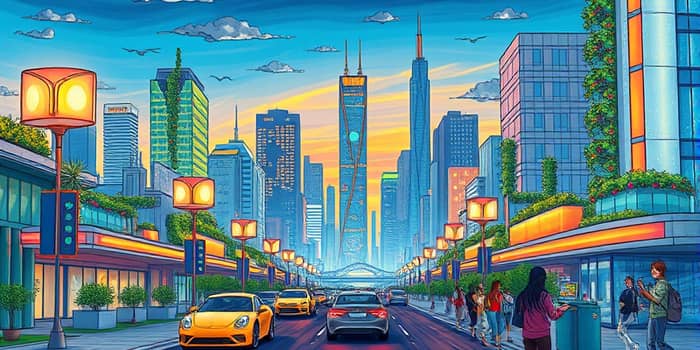
In an era where over half the world's population resides in cities, the push for smarter urban living has never been more urgent.
The global smart city market is projected to surge from USD 699.7 billion in 2025 to USD 1445.6 billion by 2030, driven by a CAGR of 15.6% and rapid technological adoption.
This growth reflects a collective effort to tackle urbanization challenges through innovation.
Smart cities leverage cutting-edge tools to create environments that are not only efficient but also resilient and inclusive.
By integrating IoT, AI, and real-time data, they aim to improve everything from traffic flow to energy use.
A smart city is defined by its use of advanced technologies to enhance urban life.
Key characteristics include connectivity through IoT sensors and data-driven decision-making with AI analytics.
This approach focuses on sustainability, efficiency, and citizen engagement.
It prioritizes human capital and governance to foster social inclusion.
Efficient infrastructure use via data analytics helps reduce eco-footprints significantly.
Ultimately, smart cities aim to solve urban problems through quality data and people-centered design.
The urban mobility market is expanding rapidly, expected to grow from USD 167.04 billion in 2025 to USD 250.56 billion by 2030.
This growth is fueled by an 8.45% CAGR and rising EV adoption.
EV sales hit 17 million in 2024, accounting for 20% of new cars.
Projections suggest over 20 million sales in 2025, capturing more than 25% market share.
By 2050, urban populations are expected to reach 70% of the global total of 10 billion people.
This demographic shift underscores the need for scalable smart solutions.
A robust tech stack is essential for smart city functionality.
These technologies enable applications like predictive maintenance and climate-responsive buildings.
For instance, AI can optimize traffic patterns, reducing congestion by up to 25%.
Data streaming and APIs facilitate seamless integration across systems.
From comprehensive analysis, key trends are shaping the future of smart cities.
Additional trends include real-time IoT data reshaping 60% of urban operations.
Traffic reductions and energy cuts demonstrate tangible benefits.
Innovations vary by region, showcasing diverse approaches to smart city development.
Expert surveys highlight that 61% prioritize real-time transit and 62% focus on traffic signals.
This data underscores the importance of integrated mobility solutions.
Despite progress, smart cities face several hurdles.
Human-centric approaches are crucial, emphasizing rights and resilience.
The 2025 World Cities Day theme focuses on people-centered design.
Governments must balance tech with social inclusion to build trust.
Initiatives like the UNDP toolkit promote responsible digital evolution.
Cities can embark on smart journeys with actionable strategies.
These steps help cities transition smoothly while maximizing benefits.
For example, India's Smart Cities Mission has seen 90% completion in key projects.
This demonstrates the effectiveness of phased implementation.
Looking ahead, smart cities will continue to evolve with emerging tech.
Trends like AI-driven transit and IoT waste management will dominate.
Scaling of robotaxis and vertiports will redefine urban mobility.
Sustainability efforts will intensify, focusing on electrification and green certifications.
Governance models will become more sophisticated, enhancing social management.
With 67% of experts expecting AI to have a major impact, innovation is set to accelerate.
By embracing these changes, cities can create resilient, livable environments for all.
The journey towards smarter urban living is not just about technology.
It is about building communities where efficiency meets empathy.
As we move forward, let us champion innovations that prioritize people and planet.
Together, we can shape a future where cities thrive as hubs of connection and care.
References