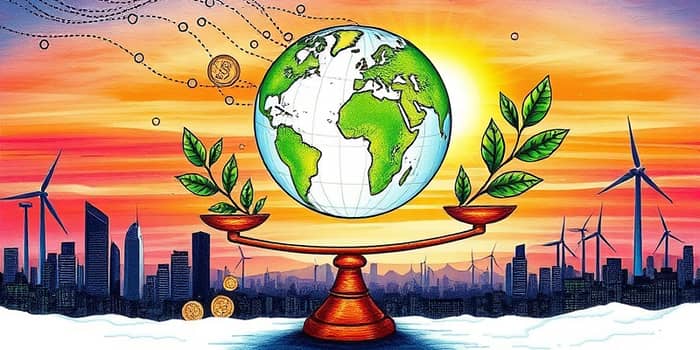
The global economy today resembles a vast ledger, recording not only flows of money but also the undercurrents of demographic shifts, climate risks, and technological change. Understanding this comprehensive balance sheet is essential for policymakers, investors, and citizens striving for a resilient future.
At its core, the world’s balance sheet captures three interlocking dimensions:
By examining both flow and stock indicators alongside deep-rooted structural forces, we gain a holistic view of economic health and looming vulnerabilities.
Global expansion has decelerated since the pre-2008 era, slipping below long-term averages. Multiple institutions now project a steady yet subdued pace of around 2½–3¼% annual growth through the mid-2020s, below historical growth norms.
The following table summarizes projections from leading forecasters:
Private-sector forecasts vary modestly. PwC sees growth easing to 2.6% by 2026, while Goldman Sachs anticipates a sturdier 2.8% in 2026, buoyed by transformative technological leaps and easing policy pressures.
The global picture masks striking regional contrasts. Advanced economies are grinding toward 1–2% growth, while many emerging markets sustain rates above 4%.
In the United States, growth hovers around 2%, with inflation risks persisting above the Federal Reserve’s 2% target. Business investment is rising, driven by digital and AI-related projects, while a narrowing trade deficit reflects shifting patterns in goods and services.
The euro area faces slower expansion—PwC forecasts only 0.9% growth in 2025—held back by weak investment and trade uncertainties. Germany and Italy are particularly exposed, while Spain shows relatively stronger momentum.
In Asia, China’s growth is moderating to around 4.6–5.0%, down from its pre-pandemic highs of nearly 7%. Exports and manufacturing remain pillars, but domestic demand softens amid property sector strains. India, by contrast, continues to outpace peers with rates above 6%, underpinned by consumption and infrastructure spending.
Many African economies are expanding around 3–5%, led by East Africa, though debt distress and commodity price volatility weigh on potential.
Global inflation is on a gradual downswing but remains uneven. The IMF projects inflation falling to 4.2% in 2025 and 3.6% in 2026, yet core prices exceed targets in the United States and certain European economies.
Central banks have largely completed aggressive tightening cycles. The Federal Reserve, European Central Bank, and others are shifting to a more neutral stance, emphasizing data dependency. Financial conditions have eased but face upside risks from geopolitical tensions and persistent tariff uncertainties.
Currencies and bond markets reflect divergent outlooks: advanced-economy yields remain elevated, while emerging-market debt is under pressure from tighter global liquidity and refinancing needs.
Beyond cyclical flows and accumulated stocks, four deep forces will redefine the world’s balance sheet over decades:
Demographics and Aging Populations
The ratio of retirees to working-age adults is rising in advanced economies. Japan already faces a 30% over-65 population, and Europe will follow. This unparalleled demographic shifts underway will strain pension systems, healthcare, and labor markets.
Climate Transition and Natural Capital
Climate change poses physical risks—rising sea levels, extreme weather—and transition risks as industries decarbonize. Investments in green infrastructure, carbon markets, and sustainable agriculture will reshape asset values and liability profiles worldwide.
Technological Revolutions
AI, robotics, and digitalization promise productivity gains but also herald labor displacement. Firms that harness these transformative technological revolutions can offset demographic headwinds, while laggards risk stagnation.
Inequality and Social Cohesion
Wealth and income disparities have widened within and between countries. High debt burdens, uneven technology adoption, and climate impacts exacerbate social fractures, raising the stakes for inclusive policy design.
To stabilize and strengthen the world’s balance sheet, coordinated action is vital. Policy priorities include:
Individuals and businesses can contribute by advocating for responsible governance, adopting sustainable practices, and investing in skills for the digital age. Civil society has a role in holding institutions accountable and fostering cooperation across borders.
Ultimately, the world’s balance sheet is not predetermined. Choices made today—on investment, policy, and innovation—will chart the course for economic resilience, environmental sustainability, and social harmony. By aligning short-term flows with long-term stocks and tackling deep structural challenges, we can write a more prosperous and balanced chapter in human progress.
References