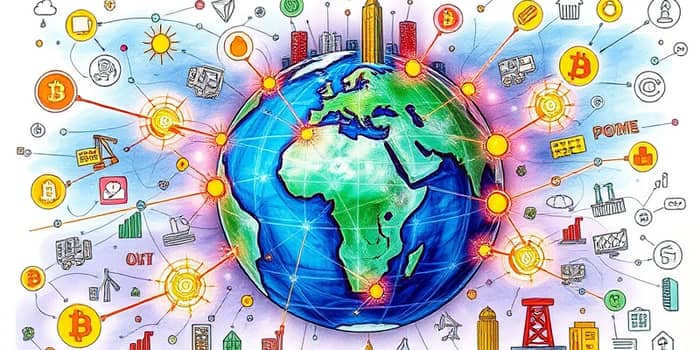
The world of investment is undergoing a profound transformation. Traditional stock and bond markets are no longer the sole avenues for growth.
Astute investors are seeking value in overlooked corners of the globe. This journey requires courage and insight.
By venturing beyond convention, one can uncover opportunities that others miss. The key lies in understanding shifts in market dynamics.
Private markets are expanding at an unprecedented rate. Secondary trading volumes are set to skyrocket.
Geographic hotspots like Asia and the Middle East are booming. AI-driven infrastructure is creating new economic engines.
However, risks lurk in the shadows. Regulatory changes and geopolitical tensions must be navigated.
This article provides a roadmap for unlocking hidden value. It blends inspiration with practical advice.
One of the most exciting developments is in private markets. Secondary market trading volume is forecasted to exceed $220 billion by 2025.
Projections show this doubling to $400 billion by 2030. This growth is driven by several factors.
Lack of distributions from IPOs and M&A has increased supply. Broader pools of capital have boosted demand.
Assets under management in secondaries are growing at over 16% annually. By 2030, AUM could surpass $1.4 trillion.
This represents a massive opportunity for value discovery. Investors can access illiquid assets at a discount.
Market fragmentation is another critical shift. Different manager sizes are adopting varied strategies.
This creates distinct opportunities across the spectrum. Diversification becomes more achievable in this environment.
Investors can tailor their approaches based on risk tolerance. The key is to stay informed and agile.
The Asia-Pacific region is at the forefront of innovation. Countries like China and Taiwan are leading in AI and semiconductors.
TSMC dominates the manufacturing of advanced chips. These chips are essential for AI and 5G technologies.
Beyond hardware, China and Japan are increasing fiscal stimulus. This supports economic growth and investment flows.
The Middle East is undergoing strategic diversification. Saudi Arabia and the UAE are investing heavily in digitalization.
Infrastructure projects are boosting corporate earnings. This region offers stability amid global uncertainties.
Europe is experiencing a paradigm shift in its markets. Initial outperformance gave way to US dominance.
Renewed focus on national security is driving investment. AI and digital transformation trends are still accessible.
Technology sectors in Europe trade above long-term metrics. But they are not at all-time highs like in the US.
These regions offer unique value propositions. Investors should consider geographic allocation strategies.
AI-driven capital spending is creating a new economic cycle. Magnificent 7 companies are expected to spend $520 billion in 2026.
This represents over 30% year-on-year growth. The impact extends beyond the technology sector.
AI capex is boosting GDP and earnings across industries. Critical infrastructure demand is already outpacing supply.
Data centers, compute resources, and GPUs are in high demand. This creates opportunities in digital infrastructure.
Private investment in energy security continues to grow. The energy transition is supported by this trend.
Investors can participate through various channels. Direct investments or funds focused on infrastructure are options.
While opportunities abound, risks must be managed. Medium-term risks include a metaverse moment.
Confidence in earnings projections could collapse after massive investment. This happened in 2022 with a 50% drop.
US power generation constraints may limit AI infrastructure expansion. This is a significant bottleneck to growth.
China scaling its own semiconductor technology is inevitable. Geopolitical risks in Taiwan add complexity.
Macroeconomic uncertainties persist with inflationary growth likely. Conflicting economic shocks create volatility.
Investors should hedge these risks through diversification. Monitoring global events is crucial.
Regulation of private markets is increasing worldwide. More diverse investors require comprehensive protections.
In the US, some regulatory loosening has occurred. But changes like upcoming ADV Form updates need attention.
Trade and tariff dynamics are shaping global economies. US tariffs continue to ripple through markets.
Uncertainty around trade agreements adds risk. However, most agreements carry upside potential.
Staying compliant and informed is essential. Policy shifts can create both challenges and opportunities.
Global equity markets are showing signs of broader growth. Resilient earnings and AI investment are driving this.
Leadership is shifting beyond mega-cap tech stocks. This offers a more diversified investment landscape.
Desynchronized global markets require varied approaches. A multipolar economy creates fragmentation.
Different geographies and industries need tailored strategies. This leads to a wider array of opportunities.
This table highlights key areas for investment. Valuation metrics should be considered carefully.
Quality underperformance in 2025 may present entry points. Both offensive and defensive characteristics are valuable.
Leveraging technology is no longer optional for investors. AI and data augmentation are necessities.
Deep human expertise must be combined with automation. This enhances decision-making and scalability.
Unpredictable markets demand innovative approaches. Operational efficiency is critical for success.
Embracing technology can unlock hidden value. It allows for faster adaptation to market changes.
In conclusion, the path to unlocking hidden value is clear. Move beyond conventional markets and explore new frontiers.
Private sectors, emerging geographies, and AI-driven infrastructure offer promise. But always balance opportunity with risk management.
Regulatory awareness and technological integration are key. The future of investing is dynamic and full of potential.
By following these insights, investors can navigate the complexities. They can achieve superior returns in a changing world.
References