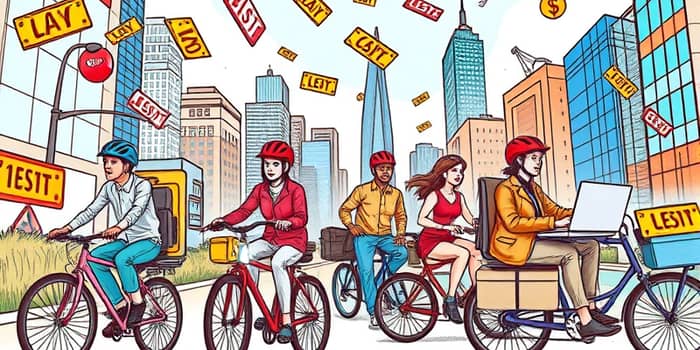
The world of work is undergoing a seismic shift. No longer confined to nine-to-five routines and traditional employer–employee relationships, hundreds of millions of professionals now navigate the gig economy, shaping careers around projects, platforms, and personal passions. As flexible work becomes the norm, one question looms large: how can these modern pioneers secure stable finances and protections when their incomes and benefits no longer arrive in neat, predictable packages?
In this article, we explore the forces driving this revolution, the financial dilemmas it creates, and the innovative solutions—both technological and policy-driven—that promise to empower flexible workers for the long haul.
Over the past decade, the gig and platform economy has evolved from a fringe phenomenon into a cornerstone of the global labor market. Today, it represents a multi-trillion-dollar platform economy, generating roughly $2.7 trillion in value and engaging 1.57 billion workers worldwide—about 36 percent of the global workforce. In advanced economies, forecasts estimate that by 2027, half of all workers will participate in gig or freelance roles at some point in their careers.
Regional growth rates vary, but the trajectory is consistent: Europe’s flexible-work market is projected to swell from €67 billion in 2020 to €180 billion by 2025, while Asia-Pacific leads with annual expansion near 20 percent. In the United States alone, 72 million Americans earned $1.5 trillion through independent work in 2024, and projections point to gig workers composing over half the U.S. labor force by 2028.
Freedom and autonomy drive many to embrace project-based careers: the ability to choose tasks, set schedules, and balance personal passions with professional goals. Yet these rewards come with significant challenges. Without a single employer, workers confront volatile, unpredictable, and platform-dependent earnings, making budgeting and long-term planning precarious.
These tensions—freedom versus precarity, autonomy versus unpredictability—underscore the urgent need for financial frameworks that align with modern career paths rather than outdated employment models.
Enter fintech and neobanks designed to serve the on-demand workforce. Across the globe, startups are pioneering tools for automated income smoothing and savings, offering real-time access to earned wages, customized micro-loans, and algorithms that forecast earnings and buffer lean weeks.
For example, a ride-share driver in Chicago might see weekly fluctuations of 40 percent. By leveraging an income-smoothing app, she secures a small safety net that tops up her account during slow periods, ensuring rent and groceries stay covered without resorting to predatory loans.
Perhaps the most transformative concept is that of portable social safety net—benefits tied to the individual rather than an employer. This model decouples health insurance, retirement contributions, paid leave, and other protections from single-job attachment, granting continuity across gigs, contracts, and entrepreneurial ventures.
Several policy experiments point the way. In the United States, Washington state’s Gig Worker Benefits Act requires platforms to contribute a fixed percentage of gross earnings into a shared benefits trust. California’s debates over AB 5 and the PRO Act have elevated the discussion of benefit portability and reclassification. International pilots—from Canada’s freelancer cooperatives to the European Union’s proposed freelancer directives—test tiered contribution schemes and opt-in benefits wallets.
Realizing a stable financial ecosystem for flexible careers demands collaboration between governments, platforms, financial institutions, and worker advocates. Key areas for action include:
By forging partnerships and leveraging emerging technologies—blockchain for transparent benefit tracking, AI-driven credit underwriting, and mobile-first interfaces—we can construct a resilient support structure that honors the ethos of flexibility while safeguarding financial well-being.
As Gen Z and Millennials continue to lead the transition to project-based work, they bring fresh expectations: a desire for autonomy, meaningful pursuits, and income diversity. Yet they also demand fairness and security. Providers that respond with holistic financing solutions and robust benefits frameworks will not only attract talent but also set new industry standards.
Ultimately, financing flexible careers is about more than smoothing cash flows or assembling benefits. It’s about fostering a world where individuals can craft their professional journeys with confidence, backed by protections that adapt to every pivot, pursuit, and passion. When financial systems evolve to match the agility of modern workers, we unlock human potential on a global scale—and build an economy that truly works for everyone.
References