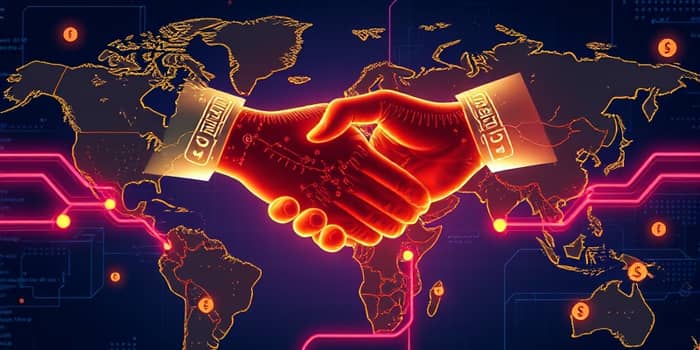
In a world where over $200 trillion moves across borders each year, artificial intelligence has become the silent mediator ensuring every transaction is swift, secure, and compliant. This is the story of how machine intelligence is reshaping the plumbing of global finance.
Cross-border payments have never been larger or more complex. With Global cross-border payment volumes expected to exceed $200 trillion by 2025, financial institutions are seeking new ways to improve efficiency, transparency, and risk management.
By 2025, revenue from these payments is projected at $222 billion, rising to $336 billion by 2031 at a 7.16% CAGR. Within this colossal ecosystem, the AI-specific market view of $6.8 billion in 2025, growing at 14.1% CAGR to $13.3 billion by 2033, signals that intelligence-driven solutions are no longer optional—they are essential.
Several macro trends have converged to bring AI to the forefront:
As these forces collide, AI becomes the unseen handshake that binds banks, fintechs, regulators, and corporates together in a vast, distributed network of trust.
The true power of AI in cross-border payments lies in its ability to interpret vast, structured datasets. Two industry initiatives have unlocked this potential.
ISO 20022 is an open global standard for financial messaging. By delivering consistent, rich, and structured data end-to-end, it equips machine learning models with granular details on every payment instruction. Since its migration began in March 2023 and will fully replace legacy MT messages by November 2025, ISO 20022 has become the new grammar of cross-border finance.
SWIFT gpi complements this by delivering near real-time visibility and speed. Its four core principles are:
With over 400,000 gpi payments daily—and more than half credited within 30 minutes—this network unleashes a torrent of high-quality data. The richer the data substrate, the more effectively AI can:
- Spot anomalies and predict delays
- Automate reconciliation for corporates
- Enhance sanctions and AML screening
In short, AI’s effectiveness in cross-border payments is directly proportional to data richness, positioning ISO 20022 and gpi as foundational pillars.
AI in cross-border payments has moved from pilot projects to boardroom priorities. Research by FXC Intelligence reveals that in 2025, mentions of AI surged in both earnings calls and press releases across payment firms.
Among 24 companies’ earnings calls, references to machine intelligence grew significantly year over year, with several firms unveiling dedicated AI strategies. Similarly, analysis of 1,173 press releases from January 2024 to March 2025 showed:
This shift in rhetoric mirrors a broader strategic embrace: AI is now embedded in mainstream communication, signaling that it has transcended experimentation to become a competitive necessity.
From compliance to optimization, AI is delivering tangible benefits across the payment lifecycle.
Fraud detection, AML, and sanctions screening represent the most mature applications. Leveraging ISO 20022’s semantic richness, AI algorithms ingest structured payment data, account metadata, and network graphs to:
Solutions like ThetaRay SONAR exemplify this trend. By deploying proprietary algorithms that deliver what the company calls “artificial intelligence intuition,” SONAR analyzes unlimited datasets to pinpoint suspicious activity with virtually no false positives. This invisible validation engine underpins trust in every cross-border and domestic transfer.
Transaction monitoring and risk scoring take this further. Advanced ML models continuously scan corridors and multi-hop routing paths to identify emerging threats. One scholarly study, based on 12 months of anonymized transaction metadata, showed that AI-driven monitoring cut fraud-related compliance failures by over 30% while improving throughput.
On the treasury side, routing optimization and FX management are also benefiting. AI-powered engines analyze market volatility, network liquidity, and fee structures in real time to suggest optimal routing paths and execution times. By dynamically adjusting to corridor conditions, these systems can shave basis points off forex costs and accelerate settlement.
As evidence accumulates, the business case for AI in cross-border payments strengthens:
These projections underscore that as the total addressable market expands, so too does the share held by AI-driven innovation.
Despite remarkable gains, hurdles remain. Data privacy regulations, model explainability requirements, and the need for continuous training on evolving threats all demand robust governance frameworks. Yet each challenge also represents an opportunity for collaboration between banks, fintechs, and regulators to reinforce the invisible handshake of trust.
Looking forward, we can expect AI to:
- Drive hyper-personalized payment experiences for both businesses and consumers
- Enable predictive liquidity management across global networks
- Unlock new financial inclusion pathways in emerging markets
The future belongs to institutions that treat AI not as a feature, but as the infrastructure of cross-border finance.
The $200+ trillion cross-border payments ecosystem is undergoing a profound metamorphosis. AI’s invisible handshake permeates every transaction, silently ensuring speed, security, and regulatory compliance. As ISO 20022 and SWIFT gpi lay down the data rails, machine intelligence rides on top, transforming raw information into actionable insights.
For banks, fintechs, and corporates alike, the message is clear: embrace AI now or risk being left behind. In a landscape defined by complexity and scale, only artificial intelligence can bind global networks together in a single, trust-filled handshake.
References