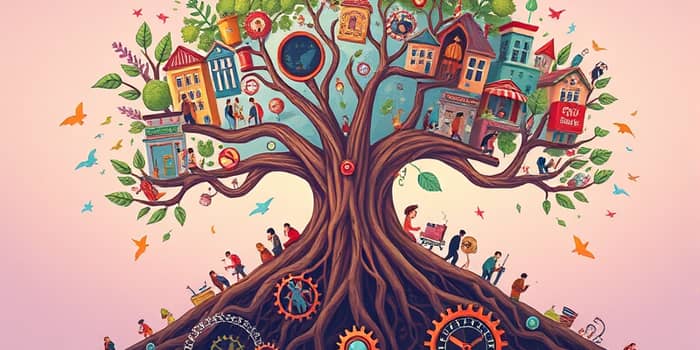
In both nations and individual lives, vast resources often falter, while small design choices drive lasting prosperity. This article explores that paradox and offers practical strategies for crafting prosperous systems and habits.
Prosperity emerges not simply from pouring in resources but from creating the right conditions for growth. On a macro level, countries that focus on market-creating innovations are true engines of broad prosperity witness sustained economic transformation. On a micro level, individuals who build automatic financial behaviors aligned with goals often outpace high earners who rely solely on willpower.
This paradox—where big inputs yield little output, but small, intentional designs unlock vast potential—applies across scales. By examining development history alongside personal finance, we uncover the common design principles that generate durable wealth and opportunity.
Clayton Christensen and colleagues define prosperity as “the process by which more people improve their economic, social, and political well-being.” They observe that traditional aid and infrastructure projects often fail to deliver lasting results. Instead, true prosperity arises when entrepreneurs target nonconsumers with radically lowering cost and complexity solutions.
Three types of innovation clarify this dynamic:
Market-creating innovations (MCIs) transform complex, expensive offerings into accessible, affordable solutions, turning nonconsumers into active participants. This process generates new demand, creates jobs, builds infrastructure, and draws supporting institutions.
China’s dramatic decline in extreme poverty—from 66% in 1990 to under 2% recently—tracks closely with widespread MCIs that scaled affordable goods and services for millions. Contrast this with countries that invested heavily in top-down infrastructure without nurturing underlying market capabilities.
These stories illustrate how nonconsumption as oceans of demand becomes the launchpad for self-sustaining growth when design focuses on real user struggles rather than superficial fixes.
Foreign aid, mega-projects, and copying rich-country institutions often yield temporary gains in indicators but fail to create ecosystems of opportunity. The real development lesson is that fall in love with problems—a principle urging innovators to deeply understand local “jobs to be done” rather than impose outside solutions.
Successful nations build capabilities and markets first, then institutional layers follow. This inverted sequence—capability then wealth, not wealth then capability—underscores the need for intentional design of incentives, regulations, and business models.
Just as countries thrive through MCIs, individuals can build wealth by structuring their choices and environments intentionally. Behavioral economics shows that design context for better decisions often trumps raw willpower.
Key elements of personal design include:
By embedding these features into financial systems, individuals reduce friction and default into beneficial behaviors, replicating at a personal level the market-creating principle of simplifying access and building infrastructure—in this case, financial infrastructure.
Systemic design blends systems thinking and human-centered design to address complex social challenges. It involves mapping interdependencies, identifying leverage points, and designing for long-term adaptation rather than one-off fixes.
Similarly, life design applies these methods at the personal level. By auditing daily routines, environmental cues, and decision flows, one can engineer habits that support career growth, health, and financial stability simultaneously.
For example, designing a morning routine that pairs exercise with financial education creates momentum across domains. This cross-disciplinary approach mirrors how robust markets pull in diverse supporting institutions—a principle that holds from villages to portfolios.
At both national and personal scales, the same patterns emerge:
These steps forge a continuous growth cycle, where small, deliberate design choices compound into transformative outcomes.
Whether you seek to stimulate economic development or engineer personal wealth, begin with deliberate questions:
By adopting a designer’s mindset—rooted in empathy, iteration, and systems awareness—you unlock both societal and personal prosperity. This is the heart of the prosperity paradox: the largest gains come not from more resources, but from smarter design.
Through intentional design at every scale, we transform latent potential into thriving economies, resilient communities, and flourishing lives. The key is to think like a designer: craft environments, incentives, and habits that nudge growth into being, and watch prosperity unfold.
References